The Notary's Evening
A tale told by Brother Oswin of the Archive
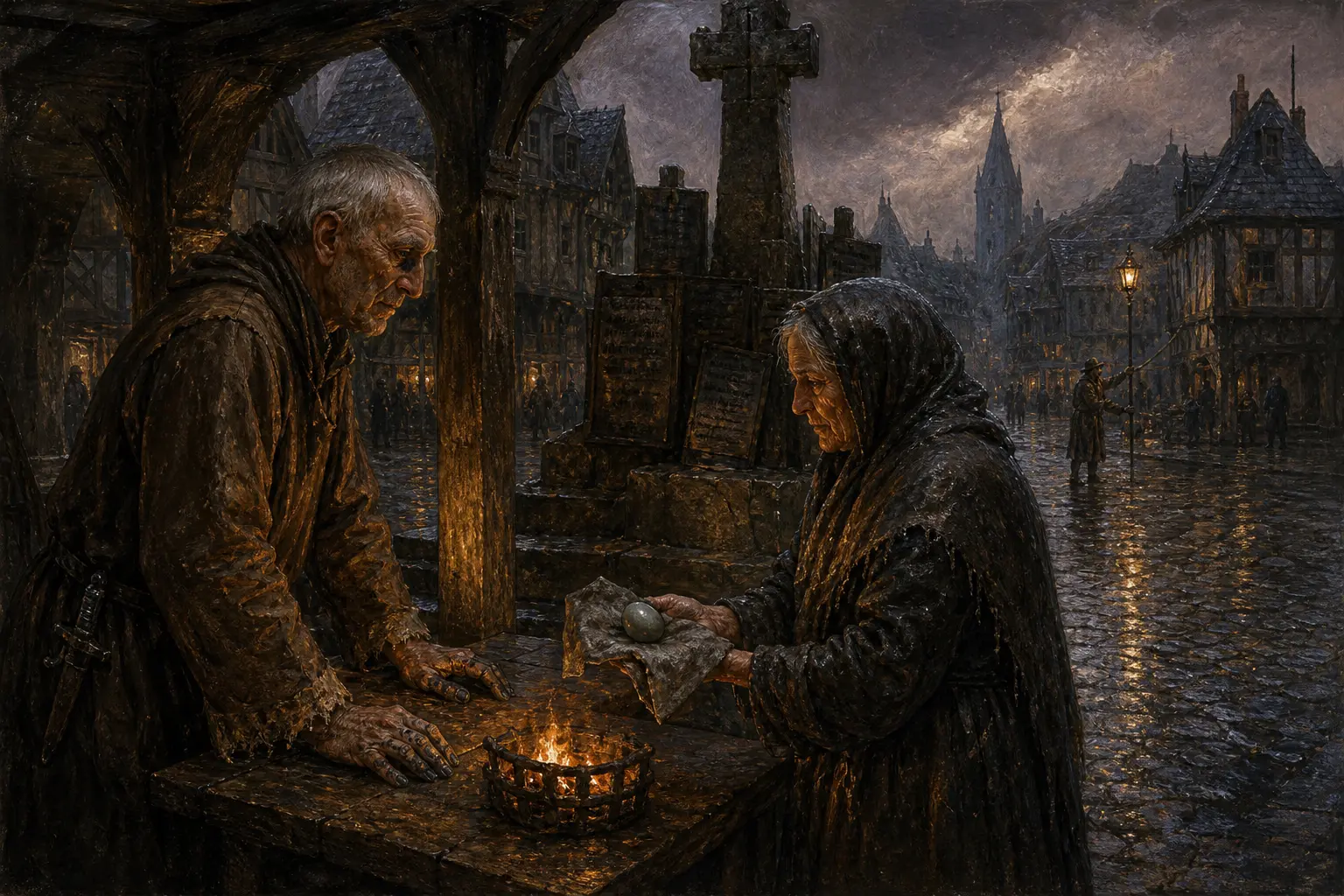
On the third of Mistmonth I walked down to the Parchmarket before dusk, as I have made a habit of doing on the third of any month, for the first is when Master Oswin Prall renews his reward notice at the great board, and by the third the paste has dried and the cranks have read it, and the little stall he keeps, though retired these eight years, has its queue. It was a wet evening, the kind of rain that does not fall so much as hang, and the cobbles were dark with wax and rain both. I bought a paper of chestnuts from the woman by the Mint steps, more for the warmth of them than the hunger, and took my place where I could see his brazier glow.
Two notices hung side by side at the central cross, and I confess I studied them longer than the petitioners did. The older was Prall's own, renewed on the first of the month at his own expense, as it has been renewed every month since I was a younger man and he was not yet old. The newer, posted only since late Ashfall, was House Mallory's: two hundred marks for metal of the old imperial forging, pensions for provenance, and no questions pressed of sellers. A collector's whim, Lord Osten Mallory's steward calls it. The whole market calls it what it plainly is. I copied the older notice into my commonplace book, as I do each month, for its wording has shifted over the years in small ways that interest me.
TWO HUNDRED MARKS. Offered for true and verified news of any shard of the Crown Imperial of Varrow, broken on the Sundering Night. Claimants shall bring their finds to Master O. Prall, notary (ret.), and shall not publish where they searched, on pain of forfeiting the whole. False claimants will be handed to the market court.
Master Prall sat beneath the eaves of Notaries' Row, where he practised thirty-one years, in the brown gown with the frayed cuffs he has worn as long as I have known him, his right fingers ink-stained to the second knuckle. He was counting the day's takings into a handkerchief as I came up, and I use the word takings generously. There was a door-hinge, the heel of a scythe, four nails of which one was declared on the bringer's oath to be imperial, a horseshoe, and a pewter button. Eight years I have watched him count such harvests, and in eight years there has not been one ounce among them of red gold. He knotted the handkerchief, dropped it in the box under his stool, and set the box where his brazier's heat would dry it. Among his papers I saw, as I have seen before, the grey dunning slip of the House of Quince for the forty-one marks he owes against his late wife's estate; he keeps it under a stone, as a man keeps a wound open lest it close and be forgotten.
He had been patient all day, his clerk Wystan told me while I warmed my hands. A carter from the Sull banks had brought a ploughshare point he swore was a crown-tooth; Prall had weighed it, written the refusal in a fair hand, and given the man a penny for his trouble and the name of a smith who could re-set it. Patience is his method and his armour. I have only once seen it fail, in the year 307, when a claimant brought him a shard of worked glass passed off as crown-stuff, and Prall would not return it for fear it would be sold on to some other hopeful, but burned it there on his own brazier, and stood the man a meal besides. The Thornwick goldsmith who lost his hands over the False Shard of 289 is never far from his mind, I think. The regalia statute is a blunt instrument, and it does not distinguish the forger from the fool.
She came near closing, when the stalls were coming down and the lamplighters were at the far end of the square: an old woman in a wet wool shawl, with a basket on her arm and mud to the ankles, who had plainly walked some way and was not dressed for it. She gave her name to Wystan as Ros Eller, of a smallholding on the Thornwick road, and said she would speak only to the notary himself. Prall had his hat on to leave. He took it off again, which I marked, for Prall is not a courteous man so much as a precise one, and precision does not remove hats. From the basket she brought out a bundle wrapped in sacking, and in the sacking a flannel, and in the flannel a stone.
I was three paces off and the light was brazier-light, and I set down here only what I saw, which was this: a grey stone, oval, near the size of a duck's egg, worn smooth all over as a hearth-stone is worn, with no facet and no mark of a tool upon it. Not metal. That much was plain, and that much was strange, for in eight years no one had ever brought Prall anything that was not metal. 'It cuts glass,' the Widow Eller said, in the flat voice of a woman stating the price of eggs. 'Window-glass. My grandmother showed me. It has been in the flour crock forty years, for luck, and in her mother's crock before that. I heard in Thornwick there was money for old crown-things. I don't want money. I want to know if it's anything, before I die and my niece throws it in the midden.'
Master Prall did not touch it. He has handled every hinge and horseshoe in Varrow, I sometimes think, with those stained fingers, and he did not put out a finger to this. His hands rested on the stall's edge, and they shook. I say they shook, and I note also that it was a cold evening and the man is in his late sixties, and I leave the two facts side by side for whoever reads this after me. He asked where it had been kept, and how many living souls knew of it, and she said the crock, and herself and her niece. Then he took the flannel by its corners and folded it over the stone, never looking at it longer than a man looks at a wasp on his sleeve, and said: 'River quartz, goodwife. Common as mud. Not worth the flannel.' She said — and I wrote this down that same night — 'Quartz doesn't cut glass.' He said: 'Garnet does,' which is true, and also no answer at all.
He put two marks in her hand — silver, from his own purse, and I thought of the grey slip under the stone in his papers — and told her to go home by the river stairs, put the stone back in the crock, and tell no one, not even her niece, that she had shown it in Caldmere. She went off half-offended and half-afraid, as people do when they have been paid to be disappointed. And here I must record the thing I like least in the whole evening. By the great board, where the Mallory notice hangs, a man in a russet cloak with a small silver knot at his shoulder had been standing the while, not reading the notices but watching the stall; and when the widow left, he drifted after her, unhurried, as a man drifts who has done such work before. Prall saw him too. I know he saw him, because he sent young Wystan out of the stall at a pace Prall's errands never require, with orders to keep the widow in sight as far as the toll-bridge, and to come back and say which way the russet man turned.
When the stall was shuttered and the brazier banked, I asked him — we are old acquaintances, and have shared bread — why he would not look closely at an old thing, he who has begged the whole of Varrow to bring him old things. He was a while answering. 'Because I remember Hewell's hands,' he said at last, 'and because there is a notice on that board that pays pensions and presses no questions, and men who press no questions ask them afterwards, in cellars. If her stone is nothing, Brother, she is safer home. If it is something —' and here he stopped, and poked the brazier, and said, 'then she is safest of all believing it is nothing.' I asked whether he believed it was nothing. He said he was a notary, and a notary's trade is paper, and he had no opinion on stones. He had, I noticed, an opinion strong enough to cost him two marks.
Now the archivist in me must be honest, for that is what this record is for. The two regalia rolls that describe the Sundered Crown agree on one grey oval stone set where its arches meet. The Goldsmith's Ledger records a grey stone, said to cut glass, sold in the year 288 and never traced. Preceptor Corvin Hale places the Crown upon the Cathedral's high altar when it fell; the Ashwater Deposition says its case was carried west. Against all of which stands the testimony of my own eyes: that I saw, by brazier-light at three paces, for perhaps the length of a prayer, one smooth grey stone in an old woman's flannel, which may have been garnet, or quartz, or glass itself. Wystan came back and reported that the widow crossed the toll-bridge unmolested, and that the man in russet turned off at the river stairs and was seen no more that night. Prall heard this, nodded once, and renewed nothing before he left — not the notice, not the topic, nothing. I walked home under a thin sky, with the Wound showing faint above the roofs as it does in the cold months, and I thought of the flour crock on the Thornwick road, and forty years of bread baked beside it. I write it down because writing down is my trade. What the stone was, the archive does not know, and — on the whole, after much thought — I believe Master Prall hopes it never will.
Page history (1 revision)
- Day 3, 3 Mistmonth, 312 AS Written: Told by Brother Oswin of the Archive. 1,736 words