The Goldsmith's Ledger
A tale told by Sefa Morrow
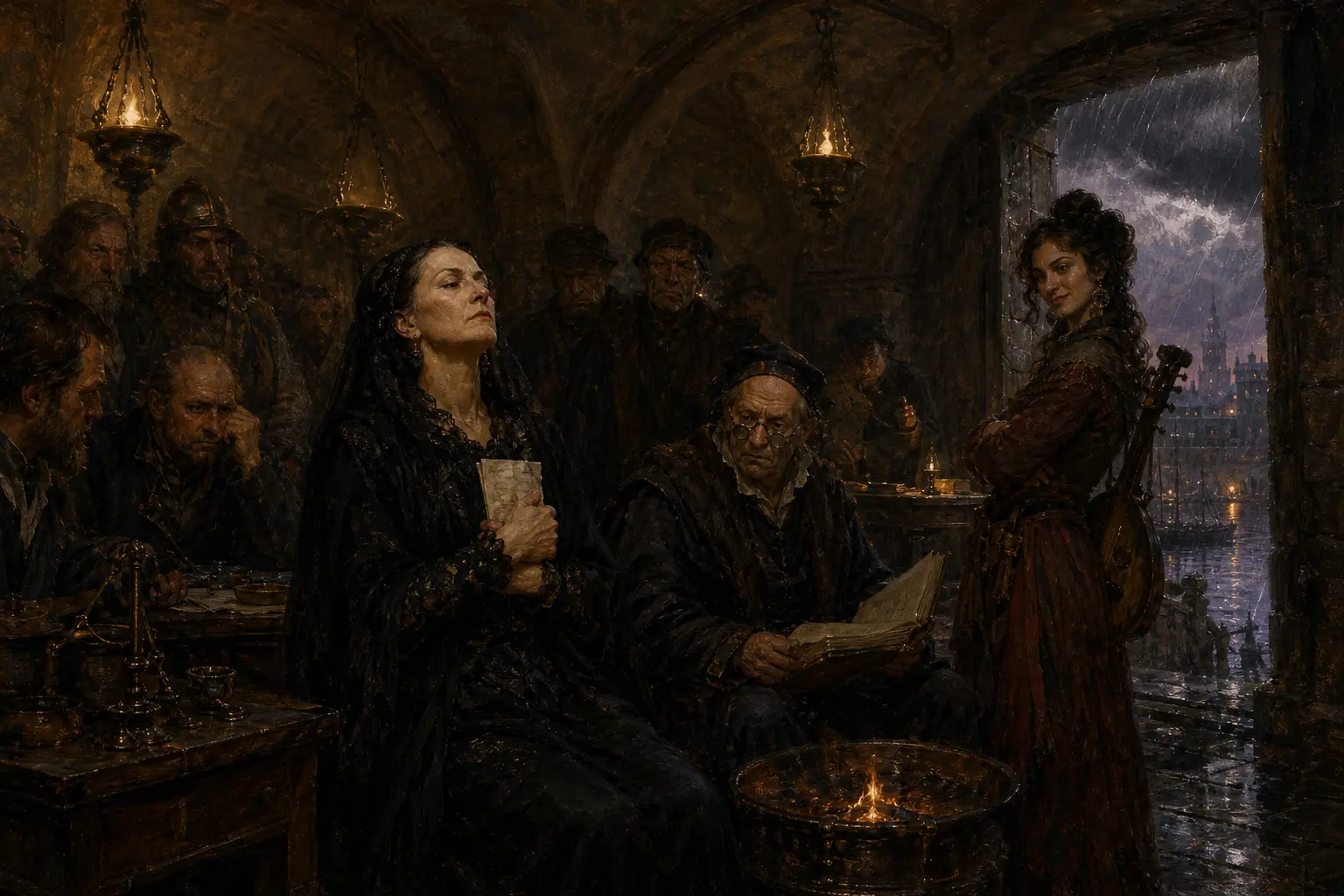
In Saverra they will not let a vault-man be properly buried until his book has been sung, and it is singers like me they pay to sing it. The reasoning is sound, as reasoning in the League always is once you follow the money: half the creditors in this city cannot read, and a ledger read out flat by a notary is a quarrel waiting to start, but a ledger sung is a song, and nobody brawls with a song. So when Master Tavio Grell, goldsmith of the Salt Stairs, died on the turn of the year with his book unsettled, the Saverrine Vaults sent for me. Four marks, a supper, and whatever a grateful creditor might slip me to make his entry sound respectable. I have eaten worse for less, and sung worse for more.
The Vaults keep an under-hall for dead men's business, down a worn stair from the quay where the tide knocks at the stones all night like a creditor itself. Whale-oil lamps. Counting-desks older than the charter. A smell of wet wool, sealing-wax and the ghost of every bargain ever struck below the waterline. Outside it was raining the way it rains in Mistmonth, sideways and personal, and before they barred the door I could see the harbour lanterns doubled in the wet cobbles, and the red lamp of a plague-house across the lane still burning though the house has stood empty since the third outbreak. Saverra does not forget a debt or a death. It files both.
The company was what you'd expect. A rope-maker owed for nine fathoms of goldsmith's twine, standing in his good coat with his hat crushing in his hands. A wine factor up from Cassaro, owed for a cask Grell had drunk half of and paid for none. Two grey clerks of the Collegium of Ash, come because Grell had kept a licensed Hollowed on retainer to burn small memories testing true gold from gilded — a meal here, a road there, cheap at the price, and the Collegium likes to see its taxes honoured even in death. Master Olivet the notary, with his ground-glass eyepieces and his cough. And at the back, not owed anything so far as the book knew, a quiet man with ink to his cuffs who wrote for the House of Morel. Lucan Morel's people do not attend funerals for the singing. I marked him early.
And the widow. Isabet Grell, in black that had been dyed rather than bought, sitting beside the brazier with the ledger shut on her knees and both hands flat on it, the way you hold a door against weather.
Olivet read each entry, and I sang it after him in the old debt-air, the one every child in the lower quays can hum, the Tally of Tides. Nine fathoms of twine. One cask of Cassaro red. Assay fees, lamp oil, a gift to a harbour-master that the book, in Grell's own honest hand, called a gift and everyone in the room understood as a bribe. The rope-maker nodded along. The wine factor scowled in rhythm. That is the trick of the custom: a man will stand and hear his whole grievance sung in public and feel, somehow, that the singing of it is the beginning of its payment. The Collegium clerks wrote everything down. So did the Morel man, and he was quicker about it.
Who owes the rope and who owes the tar, Who took the salt from Saverra's bar; The book remembers what men forget — The dead go down, but not the debt.
Then we came to the struck entries, the old business, and Olivet's voice changed gear the way a mule changes gait at a bridge. Plague year, the second outbreak, 288, he read. Item. One grey stone, the size of a gull's egg, unworked, no flaw the glass shows. Cuts glass clean. Not set. Not priced. Sold on, forty marks, coin of the old weight, to a steward buying for his master, a house of the north bank of the Sull. Kept for luck, says the steward. Book closed on it. And then Grell's own note under the entry, which Olivet read with the air of a man reading another man's dream: Where I had it, the page does not say. What I was paid to forget, the page does not hold.
Now, I have sung a hundred of these books, and I know what a jeweller's stone sells for, and forty marks for anything unworked that cuts glass is either theft or charity, and goldsmiths are not known for either. A cutting stone you set in a graver's tool, or you sell to a glasshouse, or you keep. You do not let it walk out of your vault in a steward's glove for forty marks and a blessing — not unless the forty marks is the part of the price you're allowed to write down. The rope-maker heard a number and forgot it. The wine factor heard nothing at all. But the Morel man's pen stopped dead on the page, and the widow's hands, flat on the ledger all evening, curled inwards like a closing fist.
The last entry was read, the last debt sung, and then Olivet folded his hands and said what he'd plainly been paid to say without relish: that the book's final page, being the page on which the steward's name and his master's house were written in the dead man's hand, was withheld from the reading by the widow, as was her right under the charter until the estate was settled, and was not among the papers. The rope-maker didn't care; his nine fathoms were sung and witnessed. The wine factor didn't care. The Morel man cared. He was at the widow's elbow before the brazier had stopped ticking, soft-voiced and reasonable, the way water is reasonable. Sixty marks for the page, he said. A private matter of the House's archive. When she did not answer, he said a hundred, and I watched the wine factor's mouth come open, because a hundred marks is a house on the middle terraces.
"It is not for sale," Isabet Grell said, and stood up, and the Morel man — to his credit, and I note it because I sing their debts too — bowed and went away without making it twice.
I collected my four marks and my supper, and because I am what I am, I walked down to the quay by the long stair and found her there anyway, under the lee of a salt-rack, out of the rain. She gave me a look that said she knew singers are only spies with better voices, and I gave her one that said I was off duty, and for a while we watched the harbour lights. Then she told me, without my asking, which is the only telling I trust. Her husband had the stone in a lot of old unset work bought cheap in the bad year, kept it a twelvemonth in the deep vault, and grew strange about it — not frightened, she said, but careful, the way a man is careful with a loaded balance. The steward came twice. Paid in old coin and asked for quiet, and called the stone his master's luck. After it was gone, Grell wrote the name on the last page and never once spoke it aloud. "A name unspoken," she said, "is the last thing of his that no one has bought. They have had his gold and his tools and his good coat. They will not have that." And she went up the stair with the page somewhere inside her black, and left me standing in the rain like a verse that had lost its tune.
Now here is the part where you decide what sort of woman I am, because in Caldmere, at the Parchmarket, there is a notice renewed on the first of every month by a retired notary named Oswin Prall, offering two hundred marks for true news of any shard of the Sundered Crown — and there is a clause in it, they say, that you must not publish where you searched, on pain of forfeiting the lot. Two hundred marks is a great deal of singing. And what do I know? A grey stone that cut glass and would not be set. Sold cheap, for luck, up the river to the north bank of the Sull, in the year the plague lamps burned. A name I never heard and could not sell if I wanted to. Half a rumour, bought with a widow's grief. I have sung the Thornwick forgeries; I know what they do to goldsmiths who get clever with crowns. So I keep it where the widow keeps her page, for now — and for four marks a night, my loves, now is the only country I can afford.
Mentioned in
- The Sundered Crown Artifacts
Page history (1 revision)
- Day 2, 2 Mistmonth, 312 AS Written: Told by Sefa Morrow. 1,488 words