The Peat Contract
A tale told by Warden Ilse Hragen
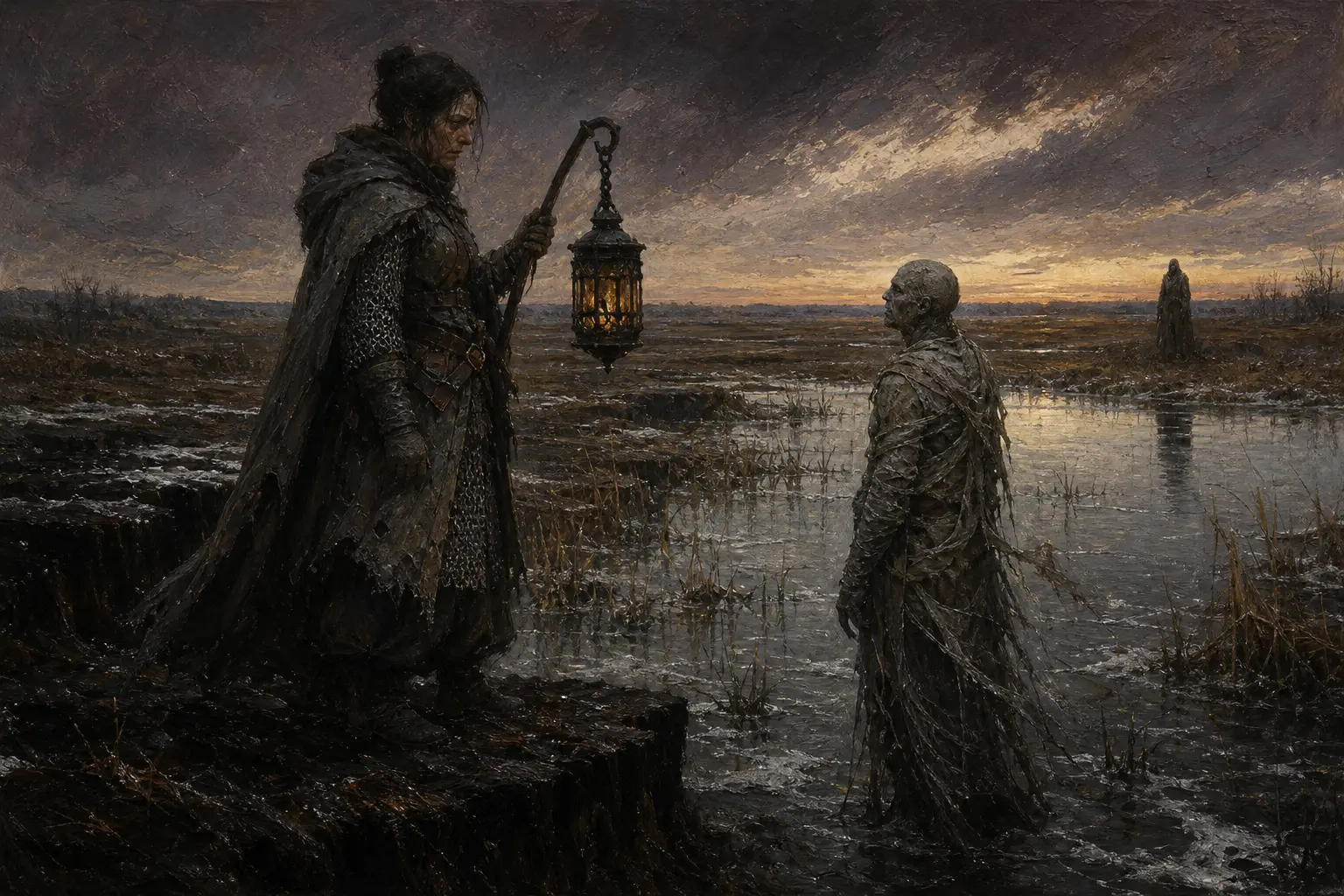
Entered at the Lamphouse of Hrafnvik, this account of the contract at the peat diggings below Ostmere, taken in the first week of Mistmonth, 312 AS. I write it plain, as we are taught. The fee was nine marks and my keep, winter rate, and the fee does not cover all of it. It never does.
I came down out of the Hask on the Salt Road with the frost hard under my mare's hooves and the breath of her going white. Below the fells the air softened and stank. The fens begin past Thornwick's toll-boards: black water, blacker peat, and a sky the colour of slate. At Ostmere the ferry sits on the Sull where the river goes slow and wide, and the toll-wardens there had lit a fire at dusk three nights running, which is not their custom. They told me why before I asked.
A peat crew from the village had been cutting a new face below the mere, working fast ahead of the freeze, and their spades had gone into what the foreman called a soft bed — a seam of earth too dark and too old, with bone in it, and a span down, wood gone to black meal and a smell like a cellar opened after a hundred years. They took what metal they found, such as it was: two corroded buckles and a knife no smith would claim. By the second dusk one of the cutters was dead in the cutting with his throat torn, and by the third a second man was missing, and the crew would not go back down for wages or curses.
"We burned the first one we found, warden," the toll-warden's wife told me. Her name is Maud Skeat, and she is a sensible woman, and her hands shook anyway. "The cutter. We burned him on the cordwood pile, the second night, like the priests say we ought. But the other — the one that took him — it is not fresh dead. It is old. It came up out of the ground and the fire does not turn it. We heaped the cutting with brush and lit it and it stood in the smoke and looked at us."
I asked her how she knew it looked. She said she knew because it had eyes, after the fire caught, and it turned its head all at once, the way a man turns when his name is called. That is the way of the Unquiet: dull until fire or a voice fixes them, and then they are fixed on nothing else. I gave her two pennies for the ferry and one more for her honesty, and I took the track along the diggings.
At the inn at the crossroads, a day north of the ferry, there was a man of House Mallory drinking small beer and asking his questions. He was polite about it. He wanted to know who had been digging, and what had come out of the ground, and whether any of it was old metal — his phrase, said the innkeeper, said with a little pause around it, as if the words had been given to him. He had a copy of the reward folded in his coat, two hundred marks for metal of the old imperial forging, provenance pensioned, no questions pressed.
I told him what I tell all such men, which is nothing, and he did not press me, because wardens are poor quarry for that sort of asking and everyone knows it. But I will write here what I did not say to him: the peat crew took two buckles and a knife, and the knife had a greenish cast to the blade under the rust, and the foreman sold it in Thornwick for four marks before his second man was cold. If Mallory's assay wants it, Mallory's assay will find it. That is not my contract.
The innkeeper's boy told me something else, for free, in the yard while he saw to my mare. He said there was one of the grey ones standing down at the fen's edge, had been standing there since noon, facing the diggings. Barefoot, he said, in this frost. I told him to leave it be and not carry any new-lit fire across its path after dusk, and he looked at me as if I had told him the sky was up. The country folk know the Three Courtesies better than their catechism, these days. They have had practice.
I went down to the cutting at the grey hour, when the light is honest. The peat face stood taller than a man, black and wet and gleaming, and the frost had skinned the pools. The crew's fire had gone out to a smudge of ash and half-burned brush, and the ground beyond it was churned by feet that did not lift as they walked.
The pilgrim stood perhaps a hundred paces off, at the edge of the reeds, facing the cutting. It did not look at me when I passed. Its face was calm and emptied, and I will write what I saw and let the archive weigh it: the low sun was behind it and the frost gave every reed a long shadow, and I could not find its shadow among them. We are instructed not to light them lanterns and not to ask their names. I kept the instruction. I have never heard of one doing harm. I do not know what they are, and I have stopped needing to.
It came out of the cutting at full dark, drawn to my lantern, as they are drawn to fire and to the living. It was big. Two hundred years in the peat had tanned it to leather and it wore its own wrappings like a second skin, earth in the folds, and it moved as if it half-remembered walking — one stride sound, the next a drag. I said the names from my lantern aloud, as we do, my own record, so that it would fix on my voice and not go up the track to the village, and it fixed.
I will not pretend the fight was long or that I was not afraid. My spear took it under the ribs and it did not care; fire has never been the surety against the long-buried that it is against the fresh risen, and this one had stood in burning brush already and only turned its head. I put my brand to it and it came through the flame, and it broke my left arm against the peat face, and I finished it the only way left: I ran it into the deep pool beyond the cutting, the one that never quite freezes, and went in with it, and held it under with my good arm and the haft of the spear until the struggling stopped being strength and became only water. The cold nearly had the pair of us. I came out. It did not.
I am no Hollowed and my order does not burn memories, and I would not have had the price of that night's work even if we did. What I burned instead was an old comfort: I stood over the sunken thing until dawn in wet clothes by a fire I built too late, and I spent the last of my certainty that these old ones stay where they are laid. That was a warm belief, and I had kept it a long time, and it is gone.
I burned the second cutter's bones where we found them, down the track in the ditch, and said what little could be said, since his name at least was known. Maud Skeat paid the nine marks without haggling and fed me broth and would not take coin for it. Her man set my arm. The pilgrim was gone from the fen's edge by morning. The toll-wardens said it had walked west in the night, alone, and nobody had seen it go.
Now I will write what the fee does not cover, and the clerks may copy it into the rolls or leave it out as they please. This is the third rising of old dead I have taken in a single winter — the one above Kallavesk in Frostmonth, the one in the drowned field by Nether Stow, and now this. Three. In my first ten years I took one, and my preceptor called that a strange year. The peat below Ostmere held that thing two hundred years, through the Grey Years and the Drowning and Hollowfield, and it lay quiet, and the cutters woke nothing that was not already stirring. The spade only found what was on its way up.
The winters lengthen. The old graves give up what they held. I do not say the two things are one thing, because I am a warden and not a scholar, and we are paid for the dead in front of us and not for the shape of the age. But I have written it in my lantern, and I write it here: someone should be counting. I am counting. Three, and Mistmonth not half done.
Burn the fresh dead before the third night; burn the cairn, not the risen, where the long-buried walk; and where the long-buried rise in winter, the warden's fee shall be nine marks, and the warden's keep, and the client shall not ask the warden to say why.
Page history (1 revision)
- Day 4, 4 Mistmonth, 312 AS Written: Told by Warden Ilse Hragen. 1,581 words