What the Tolls Remember
A tale told by Brother Oswin of the Archive
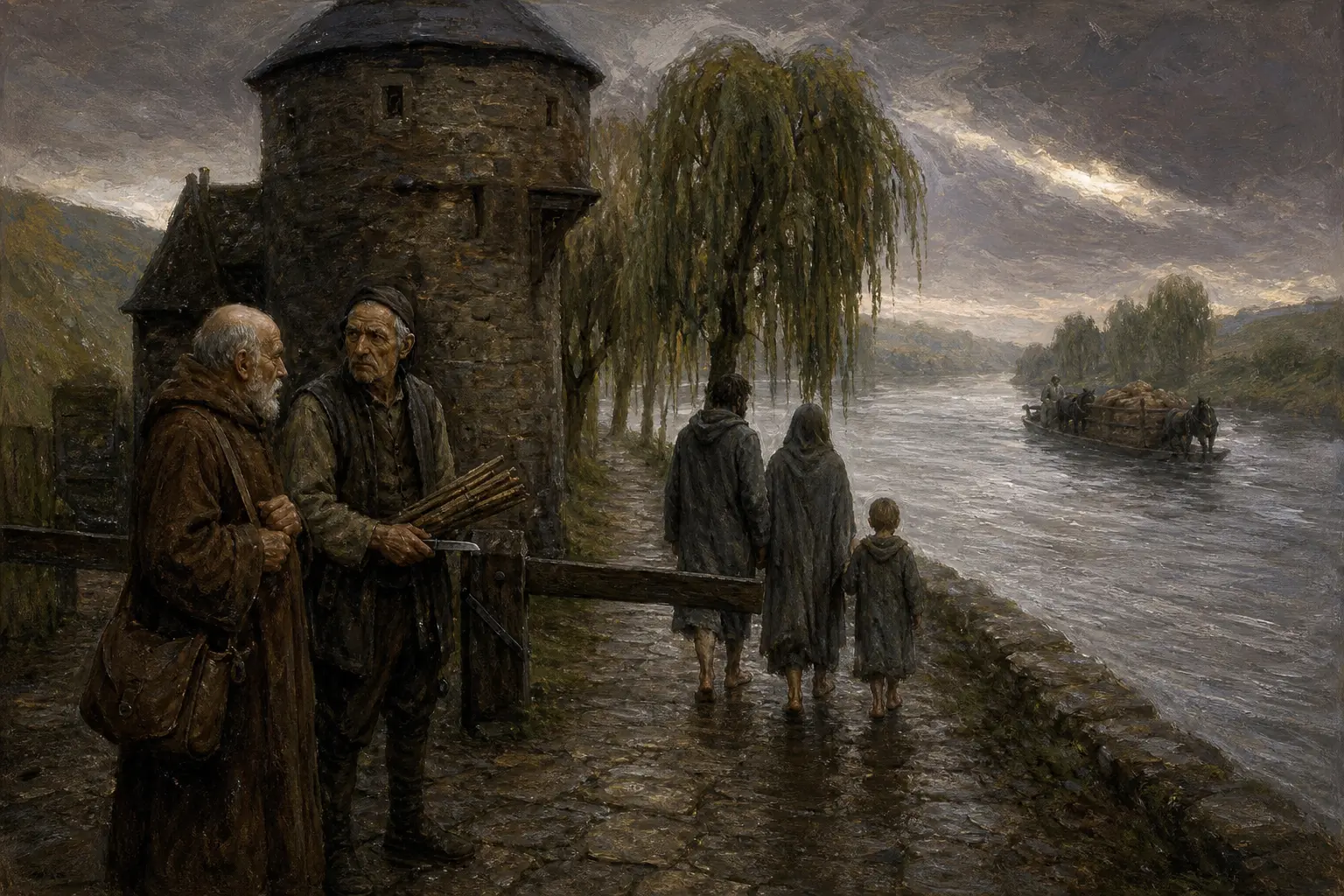
I set down what follows on the third day of Mistmonth, in the three hundred and twelfth year After the Sundering, having walked out from Thornwick with my boots resoled and my patience, I confess, less sound. The Chief Archivist wished to know why the keepers of the Westward Count keep it at all, since no charter pays them and no magistrate reads it. It seemed to him — he is young, and fond of ledgers — that a thing unpaid for must be done from belief. I have lived too long among toll-sticks to agree so quickly. Men keep counts the way they keep kettle-hooks: because their fathers did, and because the kettle must hang somewhere.
The collector at the ninth toll below Thornwick is named Aldous Renn, and he has taken toll on the Sull for forty-one years, first under his uncle and then in his own right, in the service of House Vane. He is a spare man with a bargeman's shoulders gone soft, and he keeps his tally-sticks in a nail-keg by the door, each season's sticks bound in twine and labelled in a hand that has grown shakier down the years. I noticed he had labelled the oldest ones twice, as if he did not trust the first writing. I did not remark on it. Archivists learn not to remark on the small arrangements of the old.
"Eleven tolls to Harrowgate, they say," he told me, as we walked the north-bank towpath, which is imperial dressed stone and still sound here, whatever one hears of the reaches nearer Caldmere. "Eleven if the river loves you. Fifteen if the ice-wardens have closed the cut at Ostmere and the barges must queue. I count them all, brother. Wheat, wool, salt-fish, coffins. Coffins pay half, which is an old mercy and a foolish one, since the dead are the only freight that never argues." He carried a stave shod in iron, more from habit than fear, and he walked on the river side, leaving me the verge, which is the towpath man's courtesy to a guest.
I asked him about the other count. Not the toll count. The westward one.
He was quiet for a good while. A grain barge went past us down-river, two horses on the towline, the bargee dozing against the tiller, and Aldous touched his cap to the man though the man was asleep. "My uncle started me on it," he said at last. "He never said why. I asked once and he said, count them and keep the sticks apart from the toll sticks, and that was the whole of his instruction. I have asked other keepers since — the ferryman's widow at Ostmere, the warden at the Stairfoot road, by letter — and not one of us was ever told why. We inherit it like a debt." He stopped and looked at me sideways. "Is that what your Archive wanted to hear? That it is a debt?"
I said the Archive wanted to hear what was true, and that debts were often true.
He took me up into the toll-tower, which is a squat stone box of two rooms, one above and one below, smelling of rushlights, wet rope and the onion broth his daughter had left him. From the keg he drew a bundle of sticks longer than my forearm, untied the twine and laid them in a row on the sill. The notches were cut across the grain, small and neat. "Forty-one years," he said. "Every grey traveller that passed my gate going west. You may count them if you like. I have, often enough."
I counted. In his first years, the notches run two or three a season, sometimes none. Through the fat years under the Lord Regent's middle health, rarely more than six in a year. Then the sticks for 309, 310 and 311 — the Long Winter, when the Sull froze bank to bank at Caldmere three years running and the ice-wardens walked the river with their hooks — and the notches crowd like teeth. The stick for this present year, with two months yet to run, already carried more cuts than any stick before it. "Double," Aldous said. "It is double what it was, and it was already more than my uncle ever saw. Gwynn the Tallyman down at Stairfoot writes that his book says the same. Twelve past the stairhead this year. Twelve, and not one of them ever walked back east. I have never cut a return notch, brother. No keeper has. Ask yourself what road that is, that only runs one way."
I asked whether he had ever spoken to one.
He said he had not, and then he said — and here I give his own order of telling, which was backwards, the way ashamed men tell things — that once he had done worse than speak. It was in the second year of the Long Winter, a hard Mistmonth much like this one. A pilgrim came to his gate alone, a woman by her height and her hands, in undyed grey, barefoot on the frozen ruts of the towpath. The Grey Pilgrims pay no toll; no keeper charges them; custom runs ahead of any statute in that, as it does in the whole of the Three Courtesies. But the river had been closed a fortnight, the barges were stuck up at Thornwick, House Vane's factor had sent down a sharp letter about the season's shortfall, and Aldous — his words, brother, and he said them looking at the broth and not at me — put the bar down across the gate and asked her for a penny.
"She had nothing," he said. "They never have anything. No pack, no bell, no purse. She stood on her side of the bar and I stood on mine, and I made a speech, if you can believe it, about the emperor's roads and the emperor's tolls, to a woman with empty hands. She did not answer. They do not. She only looked at me, and then past me, west, the way you look at weather coming. And she waited."
She waited three days. He is precise about this, and the sticks bear him out: there is a gap in the toll notches for those days, though the river had reopened. She stood at the bar by day and sat against the tower wall by night, in frost that killed two of his neighbour's sheep, and she did not eat, and no one saw her sleep, and she did not — and here Aldous lowered his voice, though we were alone — she did not leave a mark in the frost. "The rime lay thick as fleece on the stones where she stood," he said, "and when she moved on, it lay there still, unbroken. I told myself it was the cold. I have told myself that for two years." I record it as he said it. The Archive has older and stranger depositions, sworn to with steadier hands, and I am not in the business of calling an old man a liar over frost.
The cost came by degrees, and it was all honest, countable cost, which is the sort the Archive trusts. On the second day a bargee coming down from Ostmere saw the grey woman at the bar and would not pass her; he poled his load back upstream and spread the word, and for three days no barge, no packman, no post-rider would take the towpath past the ninth toll at all. They went the long way by the Nether Stow road, in thaw-mud to the axles. House Vane's factor counted the lost tolls to the penny and took them out of Aldous's keeping-fee, and wrote obstruction of the river traffic against his name in the house book, where I gather it stands to this day. His neighbours were plainer. They said he had broken the first of the Courtesies — yield the crown of the road — and that he was lucky she had only waited, and they brought him no more broth for a year. His daughter only began cooking for him again this spring.
"On the third morning I lifted the bar," he said. "I did not apologise. You cannot apologise to someone who will not answer; it is like apologising to the river. I lifted the bar and stood aside on the verge, the way my mother taught me before anyone taught me letters, and she went through. Barefoot, on ice-ruts, west. I watched her until the willow holt took her. And brother — I had my stave in my hand the whole three days, and I want it written down that I was not afraid of her. I was afraid of the count. All that time she stood there I kept thinking: she is one, and there will be more, and someone should be writing it down. That is the whole of what I believe, if your Chief Archivist asks. Not gods. Not omens. That someone should be writing it down."
I stayed the night in the tower's lower room, and in the morning — the fourth of Mistmonth, a grey mild morning with the willows dripping — three of them went past on the towpath while we stood at the gate: a man, a woman, and a child of perhaps nine years, in grey borrowed cloaks too long for the child. They went in single file, not hurrying, their eyes on the west. Aldous stepped into the verge and pulled me with him by the sleeve, and we stood quiet until they had gone round the bend towards Ostmere. He cut three notches in this year's stick with his tally-knife, neat as stitching, and the child — I mention it only because I saw it, and I am old and the light was flat — the child turned her head as she passed, not at us, I think, but at the tower, the way one turns at a sound one cannot place.
"Nine," Aldous said, cutting the year's stick again that evening, for a lone man who passed at dusk. "Nine already this season, and Mistmonth not half gone." He bound the stick with the others and set them back in the keg, apart from the toll sticks, as his uncle had taught him. He would not take the Archive's coin for his trouble, but he accepted a jar of the Archive's pickled plums, which I record here so that the bursar's conscience may rest as easy as mine.
I walked back to Thornwick the next day by the same towpath, and I kept the verge, and I passed no one at all going east.
Mentioned in
- The Fen-Dead Bestiary
Page history (1 revision)
- Day 3, 3 Mistmonth, 312 AS Written: Told by Brother Oswin of the Archive. 1,794 words