The Bone-Counters of the Salt Road
A tale told by Sefa Morrow
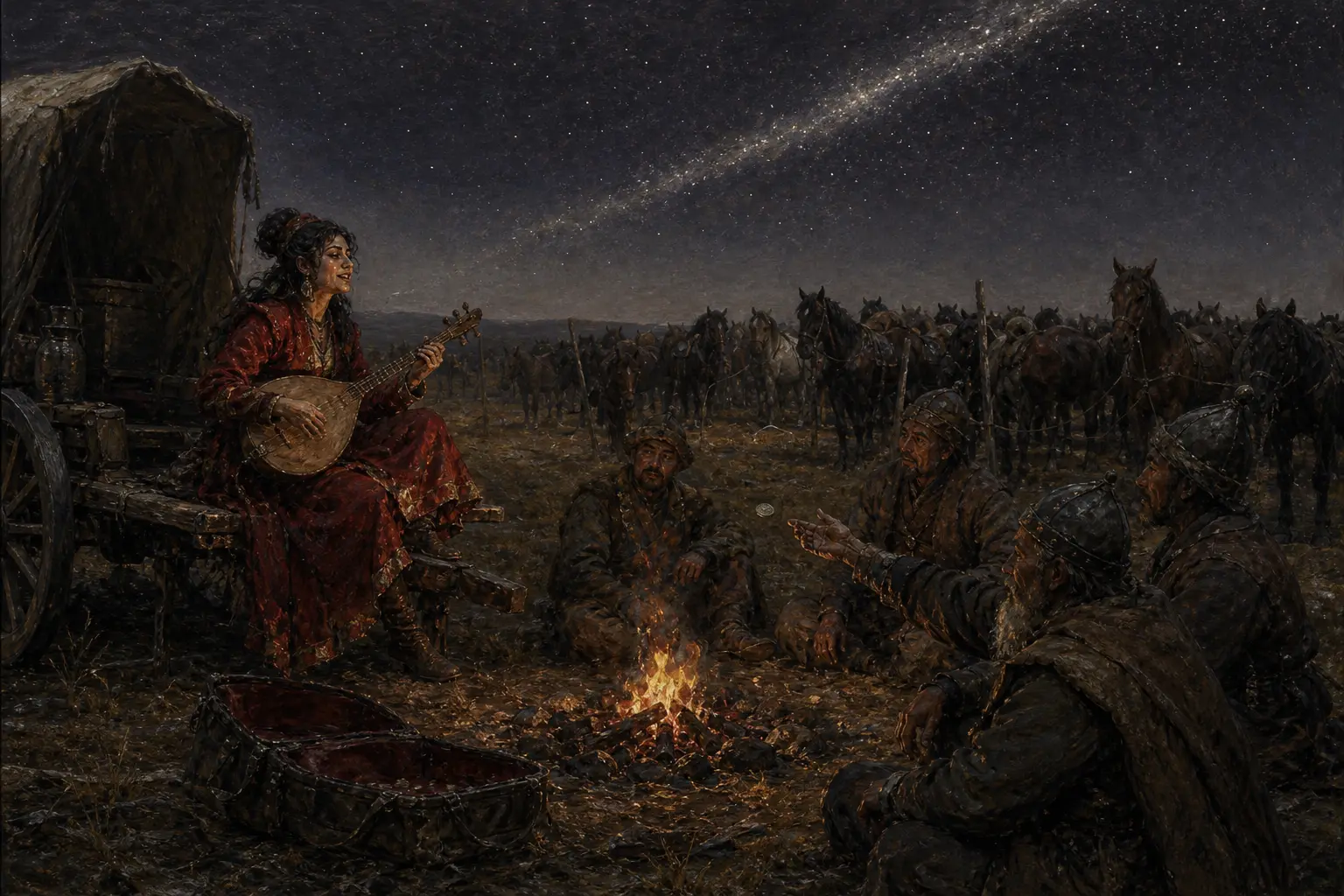
You want to know what a Khaddan grudge is worth? Then stand the wine and sit still, because I was paid in three currencies to learn the answer, and I intend to be paid a fourth for passing it on. In the last month of summer past, Master Doro Quince of the Saverran charter-house hired me to sing his horse caravan down the Salt Road from the steppe wells to Saverra before the snows took the passes. Three silver marks a week, my own knife at my belt, and my bread with the guards. A singer is cheaper than ten spears on that road, Master Quince told me, because the clans will kill a man for his boots but will not touch a woman with a lute. He said it as a compliment. I have heard worse.
We were two hundred head of steppe horses, forty League guards, and eleven Khaddan drovers riding under the road-peace, which is older than any Khagan and holier than most gods. The drovers were small-clan men mostly, and three of clan Sayle's own — forgive me, three Sayles, the young Khagan's people, which matters to the telling — and one Belgra horse-master named Ashuun, a grey-bearded man with forearms like dock rope who drove his own string of forty mares and slept beside them with a curved knife for a pillow. Sayle men and a Belgra on one caravan: that is the road-peace for you. Whatever the quarrel of the year, the salt and the horses go south, and no blood on the trail, or every clan goes hungry by Candlemass.
The steppe in late summer is all dust and distance, yellow grass to the world's edge, and a wind that tastes of the salt pans long before you see them. By night you get the stars whole, and above them that pale scar the scholars call the Wound, which the Khaddan name the White Road and will not point at with a finger, only with a knuckle. I saw young Yargat Sayle turn his cup toward it once and spill a little mare's milk on the ground, the way we southerners touch a saint's shrine, except the Khaddan do not expect an answer. Wise of them. In my experience the gods stopped answering some while before the Cathedral fell, and the rest of the world has merely made it official.
We watered at the Well of Nine Stones, where nine grey slabs stand in a ring older than any clan, and that first night I sang for my supper as hired. I gave them the tide-songs, the wreckers' counting-rhymes, the one about the factor's daughter and the eel, which translates better than you would think. Then young Yargat tossed a silver bit into my open case and asked for the Song of the Nine Fires — the Sayle one, the victor's one, all trumpets. Before I had my hand on the strings, Ashuun Belgra came across the fire and laid a gold quarter-mark on top of Yargat's silver, and named the other song. The lament. The Belgra one. Then Master Quince, who missed nothing that clinked, set three copper pennies on the pair of them and begged me, for the peace of his caravan, to sing the Song of the Drowned Diadem instead. I took all three coins, sang of drowned Ilm, and noted that grief on the steppe carries a price just like everything else, and is bought and sold the same way.
But a song refused does not die; it only waits for a darker night. Three evenings on, with the Sayle boys out riding the remuda and the fire burnt down to red eye-sockets in the dung-cakes, Ashuun told me how Temmet Belgra lost the ninth fire at the Gathering of Nine Fires in the year 308. You must understand how the clans choose. Nine great clans, nine fires, built of thorn-bush and horse-dung as high as a man. When a candidate is named, any rider who is for him casts a blackthorn brand into his clan's fire, and the fire-keeper — always an elder woman, oath-bound and beyond bribing, officially — counts each brand as it falls, and drops a white knucklebone in a bronze bowl for every one. Three horns, and the count closes. Temmet Belgra carried eight fires of the nine, and by every account, even the Sayle one, he was the finest horseman on that field and made the finest speech but one.
The ninth fire belonged to clan Uzek, the little salt-clan, and its fire-keeper was Mother Yeska, eighty years on the steppe and blind in one eye. Ashuun's telling goes like this. The horns sounded, the bones dropped, and Mother Yeska's bowl gave the Uzek fire to Belgra by a single knucklebone. Then came the rain — out of a clear sky, mind — and in the wet and the dark a brand was found lying uncounted at the fire's edge, and the count was taken again, and the second count gave the fire, and the Khaganate, to Oraq Sayle. And a League factor, Ashuun said, looking at me the whole while, had been guested three days in the Uzek tents that spring, and had left behind him a letter of credit on the Morel vaults thick as a hoof. Your people bought the ninth fire with paper, singer. He said it without heat, which was worse. Then he sang me the lament his clan sings where no Sayle can hear, and I have been paid twice since not to repeat it, so naturally here is the verse that matters.
Eight fires took the blackthorn, eight fires took the brand; the ninth was sold for paper out of a southern hand. Count the bones, Mother Yeska, count them once for me — the bowl was full for Belgra, and the rain put out the sea.
What do I believe? I believe it rained, because rain needs no bribing, and I believe an eighty-year-old woman with one eye can miscount, because I have miscounted change sober. But I have also seen what a Morel letter of credit can purchase in a poor country, which is anything not actually on fire. The truth, my loves, is a commodity like salt: it keeps well, it travels far, and it is priced by the buyer. The Belgra price it at one stolen Khaganate. They still name Temmet their Khagan in their own tents, and drink his health first, and the health of the man on the steppe's high seat not at all.
The Sayle side I had from Yargat a week later, in the border hills where the grass gives up and the stone begins, and he gave it free, which should have warned me. Temmet Belgra, says Yargat, stood before the nine fires and promised to make the clans rich — rich the southern way, with League garrison gold for steppe sons to guard counting-houses, and Varrow march-gold to raid in winter, and League gold again to stop raiding in spring, a coin for each hand and both hands sold. Then Oraq Sayle stood up — a second son of a horse-master from the eastern grass, nothing behind him but his own voice — and swore by the White Road that the clans would kneel to no southern power, not for salt, not for silver, not for paper. The ninth fire heard him, Yargat said, and touched his knuckle to the sky. That is the whole count. The Belgra keep their own tally because the true one shames them.
And the blood? There I got two tellings and no reconciliation, only a shrug from each side and the same sum: two cousins in the stone barrows. The Belgra say a Sayle boy mocked Temmet's loss in the horse-lines on the last night of the Gathering, and Temmet's cousin answered him with a knife, and on the road home the Sayles answered that. The Sayles say the first killing came earlier and was uglier, and that their answering was law. The Khaddan do not burn their dead as the Hask do; they lay them in barrows under stones with their bridles and their best bows, and so both cousins lie whole under the grass with the whole quarrel, and neither fire went out for it, and every autumn the grass grows over and every spring it is trodden bare again. That is a feud, in one image, and you may have it for the price of the wine.
I asked Yargat whether the young Khagan meant to mend it — a marriage, a gift of mares, the usual plaster over a cracked clan. He laughed and told me instead how the Pale Choir had sent a mission to the clans two winters back, all white robes and sweet singing, to teach the Khaddan to love the White Road as a god. They taught us their prayers, said Yargat. We taught them to walk. The Choir went home to Ostrovane horseless, afoot through their own snow, and have not come again. The clans have long memories and short patience for southern notions, however prettily sung. Ashuun's grandmother, he mentioned once, at the fire, quite casually, had seen Hollowfield as a girl — the field where a southern Hollowed burned her whole self to ash to stop the Khaddan grandfathers, and died not remembering her own name. They still tell it. They tell it approvingly. Mark that, and be afraid of these people in the correct way: they admire most the enemy who paid dearest.
Now the part you may trade on, since you have been patient and the wine is low. Half a day north of the Salt Stairs, where the road leaves the grass and steps down toward the coast, twenty riders came out of a dry watercourse under a black horsehair standard: Belgra, every one, armed for argument. Their captain rode up to Master Quince as courteous as a bride and levied what he called the ninth-fire toll — one mare in twenty, or her weight in silver, payable by every southern caravan, in respect, he said, of the true Khagan. Not the Sayle horses. Not Ashuun's string, and I saw Ashuun's face when his own clan's standard came up, and it was the face of a man watching his house burn from a neighbour's roof: safe, and not glad. Only League stock. Only southern paper.
Master Quince is no coward and no fool, which in a factor is the same virtue twice. He counted guards against riders, did not like the sum, and paid — with a letter of credit drawn on his own house, which the Belgra captain read twice, folded, and kissed before tucking it inside his coat. Paper again, you see. If the League truly bought the ninth fire with paper, the Belgra have decided to be paid for it in the same coin, every autumn, at the point of twenty sabres. The Salt Compact that was sworn at that same Gathering — League tolls fixed, road free, one tax and one only — died in that watercourse, and I watched it buried, and nobody sang.
Ashuun found me at the rear of the column as we went down the Stairs, and he said it plainly, as one trader to another. Come spring, Temmet calls the clans that will come to him, and takes the tolls, and takes the horse-trade with them, and starves young Sayle's summer until the fires count again. We lost a fire, singer. We did not lose the steppe. Yargat rode ahead of us in silence, and the news rode ahead of him faster, and I will tell you for nothing that the Khagan with the scarred eyebrow heard of that toll before the first snow, from a man who reads the League's own ledger-hand and counts in it better than half the clerks on Notaries' Row.
So. I came into Saverra on the third of Mistmonth with the dust still in my hems, and found the salt-brokers at the quays already whispering the price upward, because a rumour of trouble on the Salt Road travels faster than any caravan and needs no feeding. I took my last week's fee in salt, not silver — you may applaud — and that same night I sang the Belgra lament in a harbour tavern where two steppe exiles wept into their cups and paid me gold for the verse about Mother Yeska. Then a young Sayle horse-trader paid me more to never sing it again. I took his coin too, and sang the Drowned Diadem, and thought about grudges, which are the one crop the Ember Steppe never fails: frost-proof, drought-proof, self-seeding. Salt keeps, my loves, and so does a wrong, and the clans ship both south on the same road — and one of them, mark me, is going to cost the League a great deal more than one mare in twenty.
Page history (1 revision)
- Day 3, 3 Mistmonth, 312 AS Written: Told by Sefa Morrow. 2,163 words