The Bell at Spring Tide
A tale told by Sefa Morrow
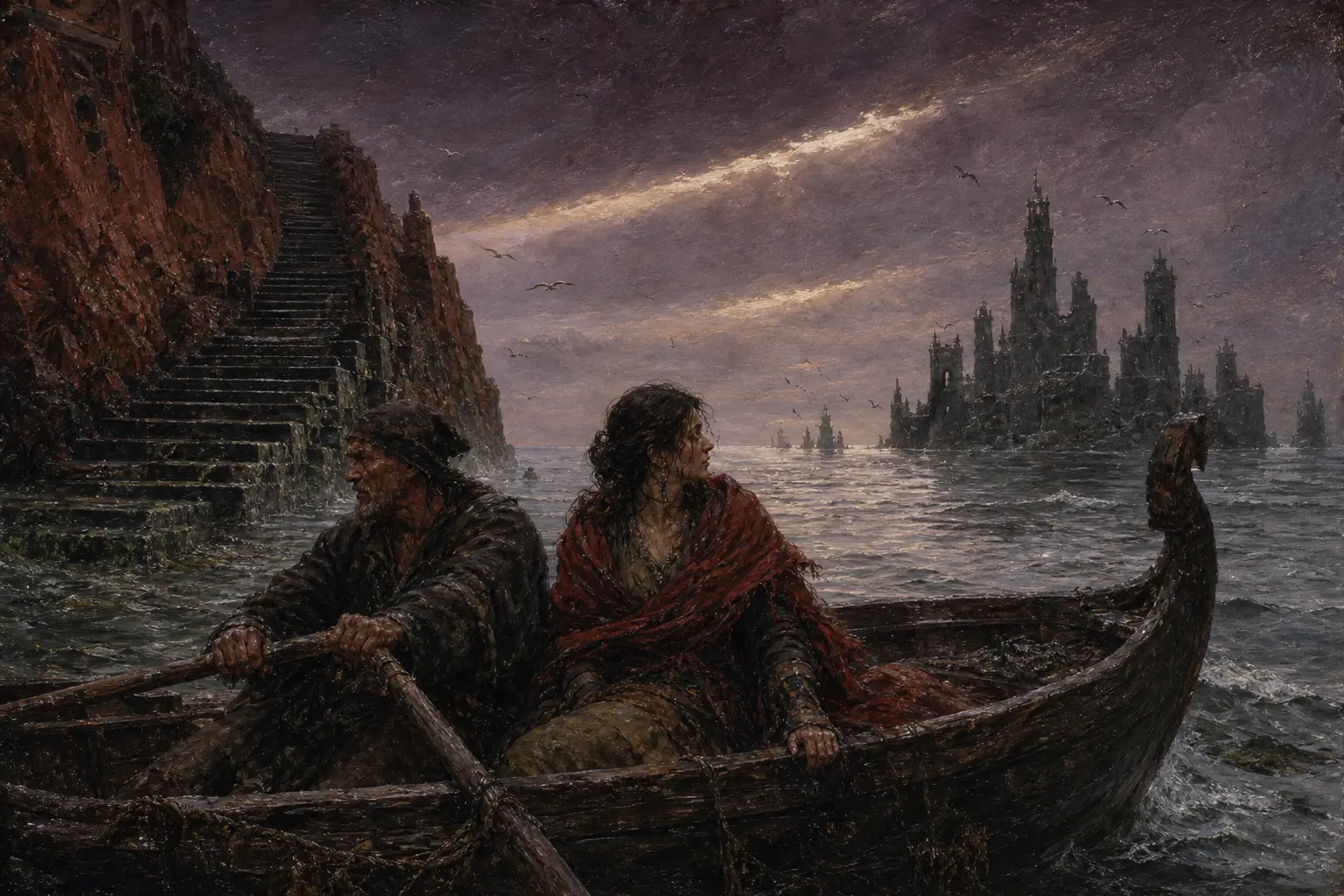
They will tell you in Saverra that I will sing anywhere for money, and that is a slander, because I will not sing for the Pale Choir at any price, and I once turned down a Morrow's Reach wedding because the bride's uncle owed me four pieces. But I will go a long way for a good story, and the best stories cost boat-hire. Which is how I came to be sitting in an eel-boat off the Drowned Coast in Mistmonth, wet to the hips, paying a fisherman to row me towards a bell that has no business existing.
Stairfoot is three hundred souls of salt and stubbornness, perched above the stairhead like a seabird that has decided the cliff edge is fine, thank you. It keeps the tide-tables and the wrecker-custom, and it keeps them jealously: I had to buy a bowl of fish stew at the Salter's Rest before they'd let me so much as look at the tide-books, which live on a shelf behind the bar between a jar of lamp-oil and a skull nobody would explain. The books go back to 141 AS at least, crabbed brown ink on salt-warped pages, and in them, plain as a tally of mackerel, the same entry made again and again by different dead hands: great tide, the Bell heard, boats in. One hundred and seventy-one years of men writing down a ghost as if it were weather.
The man I hired was Padrec Vell, whose family has blown the shore-horn for three generations, which in Stairfoot makes him practically gentry. He had a face like a rope-end and the calm of a man who has priced his own drowning and found it acceptable. "Two pieces to row you past Tregaron and back," he said, "and if the Bell sounds, we come in, and you do not argue, and I keep the money either way." I have signed worse contracts in the League, though not many.
We went out on the top of the spring tide, the biggest of the year, the sea spread flat and grey as pewter all the way to the Wound's pale scratch in the west. A mile south of the stairhead the towers of Tregaron stood up out of the shallows — the royal seat of drowned Ilm, nine black stumps of masonry, barnacled to the window-sills, gulls screaming around the tops where kings once hung their banners. Padrec shipped his oars there and let us drift, and the boat knocked softly against something below the surface that he declined to identify.
The kings of Ilm kept the Stair and the tide, so the old songs say, and the tide kept the kings.
"Nobody inventories the Bell," Padrec said, when I asked him which tower it hung in. "No Ilmish list has a bell in it. My grandfather's grandfather went over the towers stone by stone, what was left of them, and found rope and plate and a woman's comb, and no bell. Four lots have dived for it that the books record. The last was Duna Pyke, in the Long Winter. They found her on the ninth step of the Stair." He spat over the side. "Above the waterline."
I will be honest, because I am paid to be a liar and it rests me: I had come half-expecting to hear nothing and to sell the song anyway. Singers have done more with less. Then the stroke came.
It did not come through the air. It came up through the hull, through the bench, through the bones of my backside, a slow vast toll that the water carried a mile or more along the cliffs, and it was less a sound than a decision the sea made. Three strokes, slow, each one felt more than heard. And under the third — I will swear to this in any tavern in the Reach, and be laughed at in most — a fourth, fainter, that I felt only in the soles of my feet, as if something far below had shifted its weight in its sleep.
I cannot call it a bell. I have heard every bell in Saverra rung for plague and pride, and bells are made things, bronze things, and this was not. This was the sea clearing its throat.
The horn went up from the stairhead behind us, one long note, and every boat on the water turned for home — and here is the thing I crossed the towers to see, and the thing no tide-book writes down. They did not row straight in. The harbour lay north-east, plain as plain, and the tide that night was setting with it, and every boat out of Stairfoot rowed hardest while the Stair was abeam of them, bow angled a little south, so that no hull ever sat square and open to that great green-black stairway going down into the water. Padrec's oars bent like bows. His face never changed. "The set of the tide," he said, when I remarked on it, rowing as though the rope-end of him were on fire, against a tide that was, I remind you, going our way.
I looked back once. Forty paces wide, that Stair, old before Ilm was a kingdom, the upper treads salt-white and the lower ones weed-green, going down and down past the waterline to wherever it goes. And on the upper steps stood two Grey Pilgrims in their travel-grey, facing out to sea towards Tregaron, still as gargoyles, and the low Mistmonth sun was behind them and the step in front of them was bare. People in the village say the Pilgrims pause at the stairhead when the Bell tolls. Nobody says what they are listening for.
We were beached before the second horn-note, and custom held: no salvage claimed from that tide for three days, though a fine League brig's longboat came ashore on the shingle that night full of copper nails, and Stairfoot looked at it the way a fasting man looks at bread. There was a Pale Choir factor in the village that week, a soft man with ink-stained cuffs, offering coin for anything raised from the shallows with old script on it, and they would not lend him a boat at any price, which tells you what Stairfoot thinks of the Choir's interest and its 297 soundings both.
I sang that night in the Salter's Rest, for eight Saverrine pieces and a great deal of stew, and I earned it, because I sang them the Drowned Diadem and the Lamplighter's Road and not one verse about the Bell. They do not sing about the Bell in Stairfoot. It is the one thing in the Reach nobody will pay to hear twice.
The two Pilgrims were gone by morning. Nobody saw them leave, which is how they do everything. Padrec walked me to the cliff road with my eight pieces and said a thing I have not been able to set to music. "My grandmother said the Bell is not tolling at us," he said. "She said it is tolling for something, the way you ring a bell at a door. She said the polite thing, when a bell rings at a door, is not to answer it." He touched his cap and went back to his nets, and I went east with my money and my wet shoes, and I have thought about doors ever since.
Page history (1 revision)
- Day 3, 3 Mistmonth, 312 AS Written: Told by Sefa Morrow. 1,238 words