The Burned Man of Kallavesk
A tale told by Warden Ilse Hragen
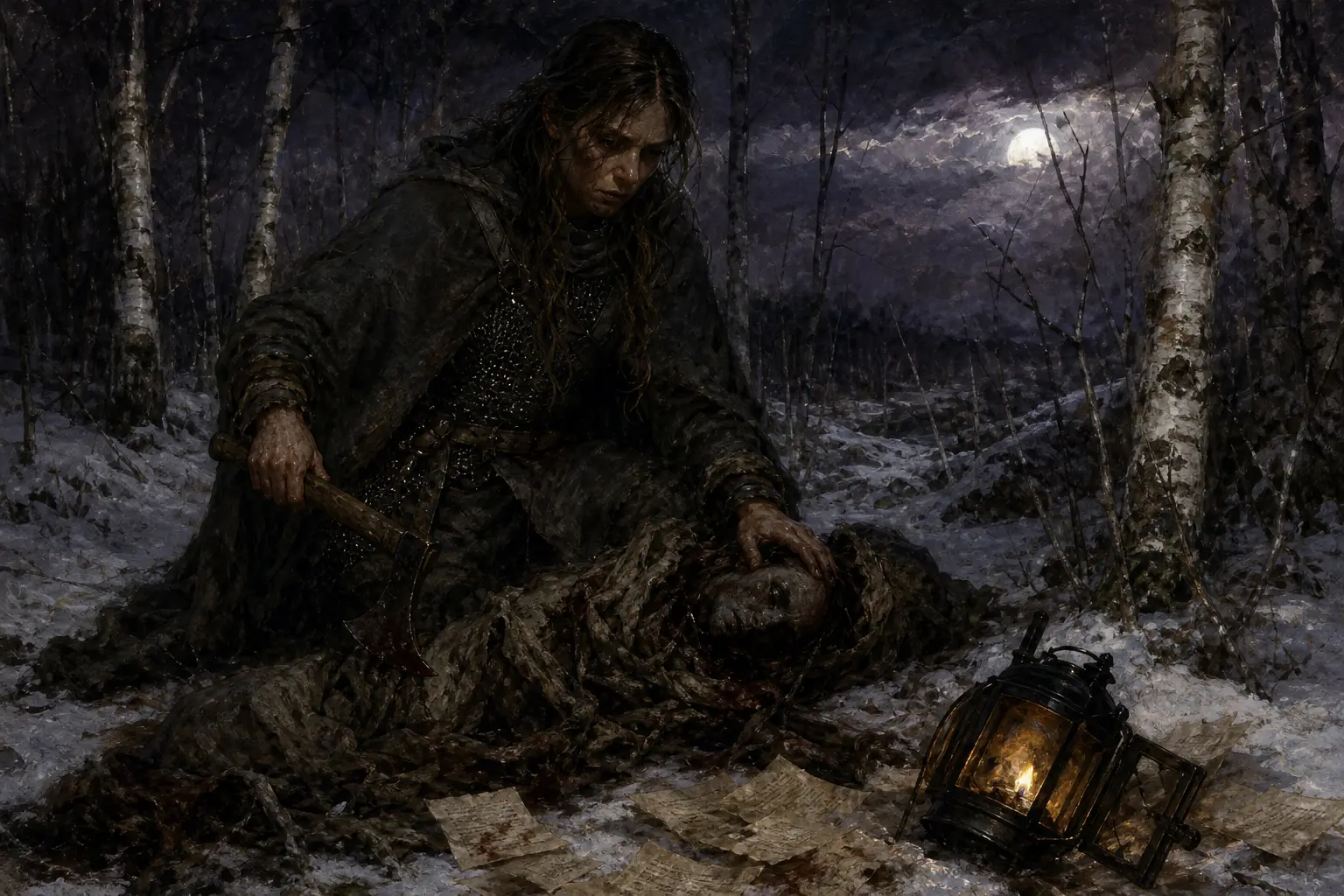
Filed at the Lamphouse of Hrafnvik, 14 Mistmonth. Contract taken at Kallavesk, nine days south along the ice-road, payment forty silver marks and winter shoeing for my horse. Contracting party: the clan-moot of Kallavesk, under Jarl Torvald Kallavesk, who is old and drinks more than he did. The matter: a risen man. I note here what the moot told me, what I found, and what it cost. I note it plainly because plainness is what a warden is for.
The dead man was Eirik Kallavesk, a nets-mender of forty-six winters, dead of a fever on the second of Mistmonth. His clan burned him before the third night, as the Hask have burned their dead since the Grey Years, and the jarl's wife swore to it, and the fire-keeper swore to it, and I believe them. I saw the pyre-scar myself on the shingle above the fjord, black and ringed with stones, the snow trampled by the clan standing witness. They did everything the old way. They sang the burning-song. They broke his nets and burned those too.
And yet on the ninth night something wearing Eirik's height and Eirik's walk came down out of the birch-wood and stood at the door of his widow's house, and her dog went mad barking, and it put one grey hand flat against the door and pushed until the bar bent. She put her children up the ladder into the loft and held the door with her shoulder and prayed to gods that have not answered in three hundred years, which I do not mock, because what else is there at that hour. It left at cockcrow. It left handprints in the frost on the door planks, and it left the village frightened, and a frightened clan is a dangerous thing to take a contract from.
I will say at the outset what I told the moot and what the moot did not want to hear. A burned man does not rise. That is the whole reason we burn. In all my years under the lantern I have put down the Unquiet in four clanlands, and every one of them was a corpse that had a body to rise in. What walks after a proper burning is not the man. The ash is still on the shingle. I checked.
So what came to widow Sigrun's door?
I spent the first day asking questions, which is most of the work. Eirik had no enemies worth the name. He owed three marks to a fish-buyer in Hrafnvik and the fish-buyer had not noticed he was dead. He had a brother, Kettil, who hated him over their mother's land and had not spoken to him in nine years, and Kettil was the first man in the moot to say what half the village was already saying: that there was a Hollowed woman living two miles up the valley, and that where ashcraft goes, the dead do not rest.
The woman's name is Yrsa, called Yrsa Hollowhand, and I went to see her before the moot could. The Hask exile the Hollowed rather than burn them, which is mercy of a kind; she had been turned out of her birth-clan in the Whitefells eleven years ago and Kallavesk let her winter in a shepherd's bothy because she closed wounds for half what a warden charges and asked no questions. She was perhaps fifty. She had the look they have, the ones who have paid heavily: a way of stopping mid-sentence while something that should be there fails to come. She kept a remembrance-book, sewn in leather, the pages soft from handling. She showed it to me without being asked, which told me she had been accused before.
"I warmed the moot-hall in Frostmonth," she said. "That is the only working I have done here all year. I burned the memory of a road. I do not remember which road, which is the point of it. Ask the jarl if his hall was warm."
The jarl's hall had been warm. I asked. I also asked her — because a warden must — whether she had ever burned a memory of the dead, or worked anything over a grave, or touched Eirik in his fever. She said no to all three, and she said something else, which I write down because it stayed with me. She said: "Warden, I close wounds. I burned the memory of my mother's face to close a miner's belly in the Whitefells, and I would do it again, because he lived. But I would not burn the dead. Whatever else you think of us, the dead are the one thing we cannot help and the one thing we cannot afford to forget."
I believed her. The order does not travel with the Hollowed and does not use their craft, and I am not here to defend it. But I know the sound of a lie and that was not one.
On the second night I set my lantern in the widow's yard and waited in the wood-line with a woodaxe and a spade, which is the truth of our trade: it is mostly axes and spades and standing very still in the cold. My lantern burned low. Inside it, in a pocket of the frame, is my own record — my name, my mothers' names, the hunts I have walked, added to year by year, because the Unquiet feed on forgetting and a written thing cannot be eaten. Every warden carries one. It is the oldest rule we have, older than the contracts, and it came down to us from the Lamplighter herself.
It came near midnight. It came the way they do, out of the birches, half-remembering how to walk, and the lamplight caught it and its dull eyes fixed on the flame all at once, the way a man turns at his own name.
It was not Eirik.
I had Eirik described to me by six people and it was not him. It was his height, as Sigrun had said, and it had his walk, or near enough in the dark, but the face above the collar of its stained shroud was longer, older, and the shroud itself was old wool rotted to grey lace. It was not wearing Eirik's shape. Eirik was ash on the shingle. This was something else entirely — an old rising, years in the ground somewhere up in the birch-hills, that had come down out of the wood and been given a name by frightened people. The village had seen Eirik because Eirik was the dead man they expected. The Unquiet do not care what we call them. They are all looking for the same thing and none of them remember what it is.
It went for the lantern, which they do, and I stepped in and took it at the knees with the axe, which is where the report should become simple, and does not.
It fell, and it caught my staff on the way down, and the lantern went over in the snow and the door of the frame sprang. The flame lived — they are made well, at Hrafnvik — but my record, my written self, thirty years of my life in folded pages, spilled out into the snow, and the risen thing, half-kneeling, reached for the pages the way a drowning man reaches. They want what is written. I have heard old wardens say it and I had never seen it so plainly: it did not want me. It wanted the paper.
I finished it with the axe where it knelt over my name. It took three strokes. Then I gathered my record page by page out of the snow by lamplight, and some of the pages were torn, and the torn part was the year of my first hunt and the name of the warden who taught me, which is gone now unless the Lamphouse copy holds it. That is the cost I record: not blood, not coin. A name I can no longer read in my own hand.
I burned the body on the shore at first light, on a new pyre, apart from Eirik's scar. I do not know who it was. It had been in the ground a long time. Somewhere up the valley there is an old grave, or a cairn the winter broke open, and the clan-moot has agreed to have the hills walked before the snows deepen, and I have marked that in the contract as done-by-others.
Now the part of this report that I write with less ease, because a warden's work does not end at the pyre.
The moot did not want my account. They wanted Yrsa Hollowhand. Kettil Kallavesk stood in the moot-hall and said it plainly: the dead man had been burned right, so the fault must be craft, and there was only one craft-worker in the valley. It did not matter that the risen thing was not Eirik, because by then the story of Eirik at the door had been told too many times to be taken back. It did not matter that I, a sworn warden, neutral by oath, told them the rising had nothing to do with her and that ashcraft cannot raise the dead — every child knows it cannot, and they nodded, and blamed her anyway, because the truth I brought them was worse than the lie. The truth is that a man can be burned rightly, in the old way, with the song sung and the nets broken, and the dead can still walk in his valley. If that is true, then nothing protects them. Yrsa at least could be driven out.
So she was driven out. Not formally — the jarl would not put it to the moot, he is old and tired and the winter is long — but her bothy was stoned two nights running, and the fish-buyer would not sell to her, and on the third day she came to me while I was having my horse shod and asked if the road to Hrafnvik was passable, carrying her remembrance-book in a cloth wrap against her chest like a child.
I told her the road was passable. I told her the Lamphouse takes in no one but that the warden stationed there would see she was not robbed on the last miles, because we are neutral, not blind. She asked me — and this is the last thing I record of her — whether I thought the dead would keep rising more often, now that the winters are lengthening. I said what I say to everyone. I said I am a warden, not an archivist, and I do not think about the shape of the age.
It was a lie. I think about it.
One further note, for the archive, since the archivists ask us to set down what does not fit. When I resewed my record into the lantern frame, I copied the torn year out of the Lamphouse duplicate, as is the practice. The Lamphouse copy of a warden's record is kept in the iron chest, and the oldest pages in that chest are the Lamplighter's own, the founder's record, the first one ever written, from which all our lanterns descend. I have read it before. Every warden stationed at Hrafnvik has. It is short and strange and it says almost nothing about her, and I had always assumed that was humility, or the fashion of the time.
This time, copying by candlelight with my record in pieces around me, it read differently. It is not that it says little. It is that it says nothing a person could not have read in a chronicle. There is no mother in it. No first home. No entry of the kind I lost in the snow — no teacher's name, no first hunt, no year that could only belong to one living woman. It is a record written by someone who understood perfectly well that written memory is the only kind the dead cannot take, and who put nothing of herself into hers.
I do not know what that means. Perhaps the earliest pages were recopied and thinned. The archivists may judge. I record only that the woman who taught us that memory must be kept safe outside the mind left none of her own where anyone could keep it.
Contract closed. Forty marks paid, shoeing as agreed. The old rising is ash on the shore. Eirik Kallavesk never rose at all. Yrsa Hollowhand is on the road to Hrafnvik with everything she remembers sewn in leather, and the clan of Kallavesk sleeps easier, believing the fault has walked out of their valley on two feet.
It has not. Something opened the ground in their hills and I do not know what, and there is a name torn out of my lantern that I will spend the rest of my life failing to say correctly.
— Ilse Hragen, Warden of the Lantern, sworn to the Lamphouse of Hrafnvik. Record read and countersigned, 14 Mistmonth, 312 AS.
Mentioned in
- The Hask Locations
Page history (1 revision)
- Day 1, 1 Mistmonth, 312 AS Written: Corrected: the body was burned before the third night, per canon. 2,183 words