A Lantern for the Mere
A tale told by Warden Ilse Hragen
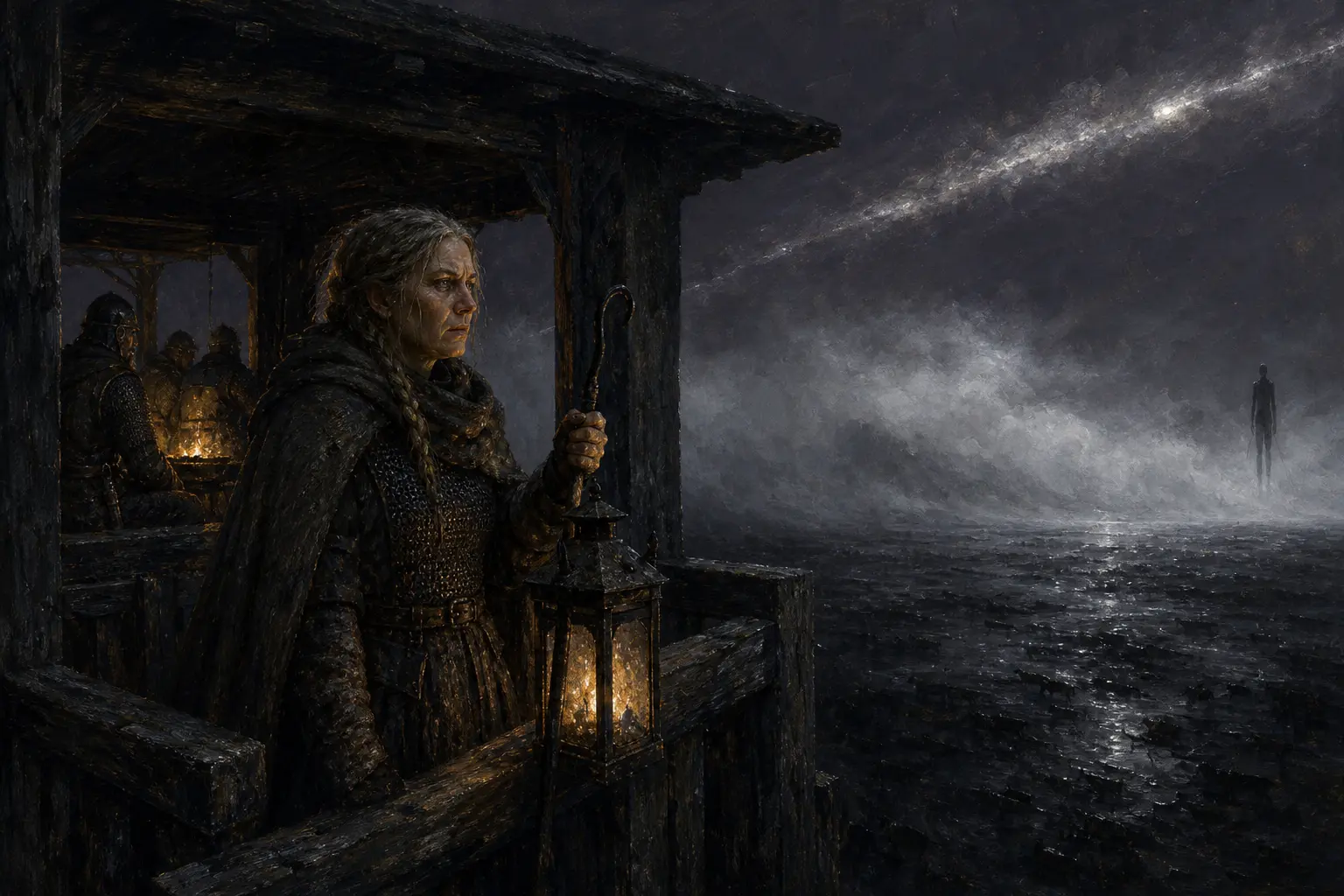
Filed at the Lamphouse of Hrafnvik, 3 Mistmonth, 312 AS. Warden Ilse Hragen, of Clan Hrafn, second warden of the southern circuit. Contract: relief of the fourth tower of the Mere Watch, at the request of their serjeant, paid at the old courtesy rate, no toll taken at the towers, none owed. I write this in my own hand before I burn the draft. What the Watch would not record, I will.
I came south out of the Hask by the Sull road in the last week of Fogmonth, and the cold came with me. It follows us down now, the winter. The bargemen at Harrowgate had already put up their ice-markers on the river. A farmer outside Thornwick offered me a goose for four pence because his fodder would not last the month and he would have to slaughter half his flock anyway. I gave him three and carried the goose on my saddle bow, plucked at the first night's fire.
The land changes before the glass does. The farms thin out. The last village, if you can call two cottages and a shrine a village, keeps its saint's niche empty; the people there leave bread in it still, out of habit, for gods who stopped answering three hundred years ago. Beyond that the grass grows yellow and then it simply stops. There is no slope, no shore. Grass, then glass, within a hand's breadth. I have seen the Glassmere twice before, at distance. It does not get easier. It lies black and faintly shining to the horizon, veined with pale cracks, and over it, even by day, hangs a low grey fume that is not smoke and is not weather. No bird crosses it. I watched a kite hunting the boundary line for an hour. It turned every time, at the same invisible mark, as a horse turns at a fence it has learned.
The fourth tower is a wooden thing on a stone footing, thirty feet of tarred oak with a bell and a brazier and a ladder instead of a stair, because a ladder can be pulled up. Serjeant Alred Pell met me at its foot. He is fifty, going soft, with a left hand missing two fingers — frost, he said, two winters back, the Long Winter took them. He had seven men under him. The muster book says the Watch is forty strong at four towers. The autumn count found thirty-one. At the fourth tower I counted eight including Pell, and one of those was a boy of perhaps fifteen whose spear was taller than he was.
"You're the warden," Pell said. Not a question. He had my letter of courtesy and did not read it; he looked at the seal and handed it back. "You'll know our orders, then."
"I know some of them," I said. "Tell me the rest."
He told me while we climbed. Fog off the glass: strike the bell, bar the doors, keep the lanterns lit, and do not pursue anything that walks out of the fog. Turn back travellers at spear-point if need be. Confiscate mere-glass chiselled at the boundary and send it to Fellbarrow — though a third of what they confiscated last year never reached the Fellbarrow stores, and Pell told me this himself with the flat voice of a man who has stopped being ashamed of needing the money. Two pence a day, three quarters of it in arrears since 310. A man will sell a shard of black glass to a curiosity-pedlar for more than a week's pay, and I cannot say, in his boots, that I would not.
"And the last order," he said, at the top of the ladder. "If anyone comes out of the Mere — alive — we take them in, we feed them, we send them south under escort. We do not ask them what they saw. We do not write down anything they say. That's the Mere Orders, and it's older than me."
"Added after 271," I said. I had read the order's copy at Hrafnvik. "After Osmund Rill came out."
Pell looked at me for a moment. "After somebody came out," he said. "The orders don't name him. Eat?"
They fed me bean pottage and black bread and I gave them the rest of the goose, which made me welcome enough. The men were what arrears make of soldiers: their mail was sound but their boots were mended with twine, and they had the patience of men who watch a horizon for a living. I asked them, in the way you ask at a fire, not in the way a warden asks, what the fog brought out. The boy started to answer and the man beside him, a grey-bearded spearman called Cunobel, put a hand on his shoulder and the boy stopped.
"We don't ask," Cunobel said. "That's the order and it's a good order. Things come out. The bell rings, the doors bar, the lanterns burn. In the morning there's nothing, or there's someone walking, and we feed them and send them south, and we don't ask."
"How often?" I asked.
He looked at the fire. "Twice since spring. Before the Long Winter, it was twice in ten years."
That is the thing I rode south to learn, though the contract says only relief of the fourth tower. Preceptor Hale wanted a warden's eyes on the Mere because the reports that reach Caldmere say nothing, and the reports that reach Ostrovane say whatever the Pale Choir wishes them to say. The Choir presses again this year to have the Glassmere declared holy ground under its governance. If the Watch is failing, Caldmere may grow tired of paying for nothing, and tired men sign papers.
The fog came on the third night, at the second bell after dark.
It did not drift. It stood up off the glass in a wall, grey-white and higher than the tower, and it came across the boundary as though it were poured, and the cold came with it, the true cold, the Hask cold that I had brought down out of the north in my baggage. Cunobel struck the bell without being told. The boy barred the door and his hands were steady, I will say that for him. We lit every lantern the tower owned and I set my own on the hook by the shutter — iron, soot-blackened, the panes clouded, and inside it, behind the flame, the folded record of who I am, written in my own hand, added to year by year. My mother's name is in there. I have not spoken it aloud in six years. That is what the lanterns are for.
Through the shutter slit I watched the fog take the world. The boundary line vanished. The last yellow grass went grey, then gone. And in the fog, at about a bowshot, something stood up out of the whiteness and stood still.
It had the shape of a person the way a stick in snow has the shape of a person. Too tall, or the fog made it so; thin; upright; not walking, not swaying, only standing, facing the tower. I could not tell you whether it had a face. The lanterns did not reach it and it did not come closer, and I want the record to be plain that it never came closer. The Unquiet are drawn to fire and to the living, and this thing stood a bowshot off from a tower full of both and did not advance one step, for the length of a hundred breaths, by my count, because I counted them to keep my hands from doing anything foolish.
Behind me, nobody spoke. I heard Pell's stool creak. When I turned, every man of the Watch was facing the wall. Not cowering — sitting, backs to the shutters, eyes on their hands or the fire, the way men sit in the third hour of a burial watch. They had done this before. This was the drill the orders do not write down: the bell, the bar, the lanterns, and then you look away, and you let it stand there until it is finished standing.
I did not look away. That is the difference between their orders and mine. Mine are the Lantern Oath, and the oath says nothing about turning your face from the dark; it says you keep the light and you keep the record. So I kept both. I watched it for my hundred breaths and I wrote, afterwards, in the fog-bell's quiet, exactly this: that it stood; that it was shaped like a person and was not one, or no longer; that it made no sound; that the cold deepened while it stood and eased when it was gone; and that when it was gone, it was not gone back — I would have seen it walk — it was simply not there, between one breath and the next, and the fog began, slowly, to sink back towards the glass.
And one thing more, which I set down for the archive and not for any report that will be bought: while it stood, the pale line of the Wound overhead was reflected in the glass beneath it, the second scar, as it is every clear night. But the fog was between the tower and the Mere, and the night was not clear, and the reflection burned in the glass anyway, brighter than the sky it was reflecting. I do not know what that means. I note it because the oath says I keep the record, and the record does not get to choose what it contains.
In the morning the fog was gone and the grass was furred with rime to the boundary and no further. The glass does not hold frost. Nothing touches it that is allowed to leave a mark.
I took Pell aside before I rode out. "How long has it been standing out there?" I asked him. "Not last night. Altogether."
He rubbed the stumps of his fingers, the way old wounds ache before weather. "My first year on the tower, it came twice and I never saw it — the older men looked away and I looked away because they did. My tenth year, five times. This year—" He stopped. "We don't count. Counting's a kind of asking."
"Count for me," I said. "I'll carry it. It's my trade."
He looked at me a long moment, and then he said, "Eleven since Thawmonth. And serjeant before me, old Wethric, he used to say — he died owing me four pence, so I speak no ill — he used to say that in his father's day the thing they watched for was people coming out. Now it's what won't come in. Whatever that means." He shrugged. "We're not to ask. You'll write it down anyway, I suppose. That's what you are."
"That's what I am," I said.
I gave him six pence for the larder, off the contract, and told the boy his hands were steady, which cost me nothing and may keep him on the tower one winter more. Then I rode north along the boundary for a mile before turning for the Harrowgate road, because a warden should not leave a place without looking at it once with nobody watching her do it. The glass lay black to the sky's edge. The centre of it has never been mapped and I did not look long in that direction, because looking felt, for the first time in my life, like a thing that could be noticed from the other side. I am not a fanciful woman. I record the feeling as I would record a footprint. It was there. I do not know what made it.
Let the file stand thus: the fourth tower is under strength and underpaid, its orders are old and its soldiers are loyal to them past reason, and the thing in the fog comes more often than it did, and does not behave as the Unquiet behave, and the Watch has been commanded, since before any of them were born, not to know anything about it. Somebody in Caldmere, forty years ago, decided that what walks out of the Glassmere should arrive in the world unrecorded and unasked. I would like to know who signed that clause, and what the last survivor said before they wrote it. Osmund Rill could not account for nine days, and lost memories that had nothing to do with the road. The orders make sure no one will ever lose so much again — or ever be asked what they found.
I have written it down. The lanterns of the dead hang in the gate-hall at Hrafnvik, and when mine goes up among them, someone will read my record aloud on the third night before they burn me, and this will be in it: that in Mistmonth of 312, in the fog off the Mere, the Watch looked away, and I did not.
We do not ask them what they saw. We feed them. We send them south. The bell, the bar, the lanterns, and your eyes on the fire, boy — that's the whole of the orders, and the rest is weather.
— Attributed to Serjeant Wethric of the fourth tower, deceased, as recalled by Serjeant Alred Pell and recorded by Warden Ilse Hragen.
Page history (1 revision)
- Day 3, 3 Mistmonth, 312 AS Written: Told by Warden Ilse Hragen. 2,239 words