The Cantor's Measures
A tale told by The Unnamed Hand
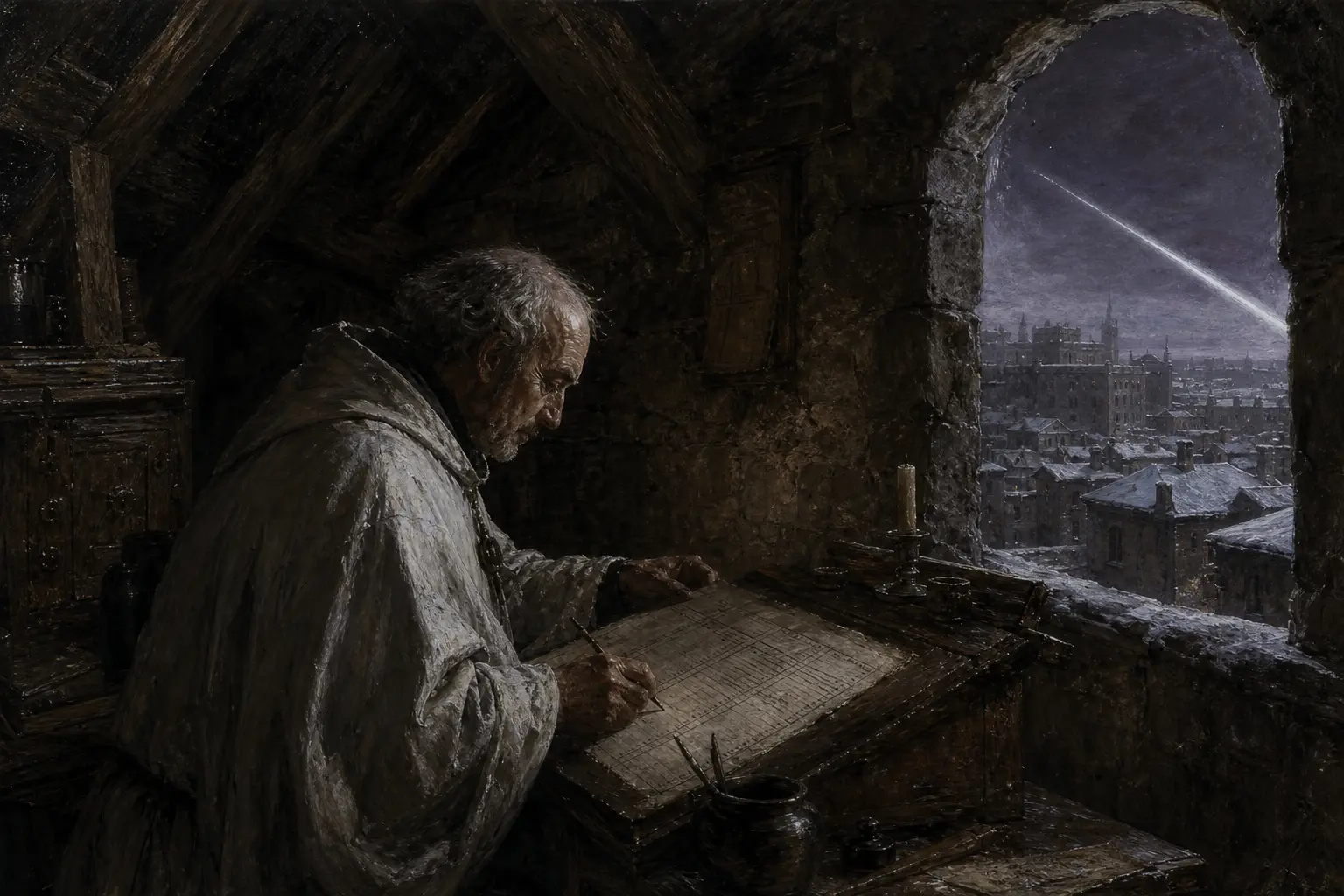
The page came to the archive as such pages do: folded into the lining of a book nobody had ordered, a commonplace commentary on the winter offices, its boards smelling of another man's stove-smoke. Whoever sewed it there knew the archive's habits, or knew mine. I have stopped asking how the things I am sent find me. I have stopped asking it aloud, at any rate.
It is a copy, not the original. The original, if it still exists, lies wherever the Seventh Circle keeps what it takes. The hand that copied it was careful and old: the figures lean a little, the way a man's writing leans when his table is cold. At the head of the page, in that same leaning hand, someone has written: From the third book of the measures of Cantor Anselm Vey, taken in the year 289. Copied before the taking. Keep it from the Chancel.
I knew of Vey, as the archive knows of every quiet man the loud world has corrected. A cantor of the third rank at Ostrovane, attached to no mission, sworn to no patron, holder of the lease of a disused watch-chamber in the cathedral's north gallery. Thirty years, from 260 to 289, he climbed his stair at dusk and at dawn and wrote down what the Wound did. The Choir preaches that the pale scar is a god's eye opening slowly upon the world. Vey measured the opening, the way a shepherd measures a lamb — not to hurry it, not to halt it, only to know.
What the page holds is a winter: the winter of 281 into 282, the hardest of that decade, when the river at Ostrovane froze to its bed and the poor of the lower city were buried in common ground because the earth would not take a spade. Vey's method is plain from the columns. Each night at the same hour he took the Wound's light against a standard — a row of small ciphers that the archive's astronomers read as comparisons to named stars, though the page does not name them. Each day he noted weather, cloud, the hour of darkening. Thirty years of this, we are told, filled eleven books. One winter of it fills this page, and it is enough.
9 Nightmonth. Clear. The Seam holds at the fourth mark, as last year and the year before. 21 Nightmonth. Cloud. Tithe-court sat late; the Cantor of the Stair preached on patience. Nothing seen. 2 Coldmonth. Clear and bitter. The Seam at the fourth mark still, though by every table of my first twenty years it should begin its deepening by now. 9 Coldmonth. Clear. Fourth mark. I have checked the lamp-glass. I have checked my eyes against the chapel candles. It is not the instrument.
Here the archive must be plain, because Vey was plain. Every measurer of the sky in the Reach, from the Collegium's shuttered ledger-rooms in Saverra to the star-keepers of the fjord-moots, agrees on one thing: the Wound brightens in winter. It is the first fact a novice learns. By summer it is a healed scar, by midwinter it outshines the stars it crosses, and by spring it fades again. The Choir says the eye strains wider against the dark. The Collegium says nothing to outsiders, which is its way of saying nothing. Vey's twenty earlier winters, the copier tells us in a cramped note at the foot, all kept this rhythm to the width of a reed-pen: the brightening began in the first week of Coldmonth, peaked at the turn of the year, and let go by Thawmonth, as regular as tithe-day.
The winter of 281 did not keep it.
Through Coldmonth the mark holds at its autumn reading while the cold deepens past anything in Vey's tables. There are small human entries between the figures, the sort a man writes when numbers have stopped comforting him. The almonry is out of bread; the Choir has opened the west granary, praise. Three houses on the Potters' Slope keep a fire day and night; an Ash-Cleric attends them, licensed and cold-fingered. Vey was no enemy of ashcraft — no sworn cantor of the Choir could be, for the Choir teaches that a memory burned is an offering given and not a thing lost — but he counted things, and a counting man notices when a cold city burns more than coal. That winter, the page records, the Ash-Clerics of Ostrovane were called out so often that the cathedral kept a sledge at the Psalter Gate for them, and the small workings of the poor — a warmed room, a found child, a stopped wound — went up from every quarter of the city like breath.
27 Coldmonth. Clear. The Seam at the fifth mark. It has leapt a full mark in a night, and in the wrong direction of the year — it should rise by grains and only toward midwinter. I write this by its light. I have never before had light enough of it to write by. 4 Hagmonth. The Seam past the fifth mark. The stars it crosses are drowned. Old Sister Mere, who has watched forty winters from the almonry roof, says she has never seen it so. She is frightened. I told her the eye sees us in our need. It is what a cantor says. I do not know what a measurer says. 19 Hagmonth. The turn of the year is past, and still it brightens. In all my books the turn is the crest. I begin to be afraid of my own columns.
The brightening held seven weeks past the turn of the year, peaked near the end of Hagmonth at a mark Vey's scale had never required before — he had to rule a new line at the top of his own table — and then, across the first ten days of Thawmonth, fell back to the ordinary readings as suddenly as a fever breaking. By the spring offices the Wound was its old faint self, a thread of milk across the day sky. The city counted its dead, the river opened, the Ash-Clerics' sledge went back into the cathedral undercroft. Vey's column for the last day of that Thawmonth reads only: Fourth mark, as it was. As though nothing had been asked of it.
A reader of this archive will ask the question the page asks and does not answer: asked of it by what? The winters after 281, the copier's note says, returned to the old rhythm, reed-pen regular, and Vey's measures ran on eight more years in the pattern of his first twenty. If one had only the books and not the year, one might call 281 a fault — a cracked lens, a sick man's eyes, one hard season misread. The Choir's examiners, when the Circle took the books in 289, called it exactly that, or so the confiscation order implies in its careful language of instrumental error and devotional over-fancy. Vey signed the order. He died four years later, sworn to silence, and the archive has no record that he ever broke it. Silence, kept to the end, is its own kind of column.
I will add what the page does not say, because an unnamed hand may say what a sworn cantor may not. I have walked in Ostrovane in winter. The city is kept bare by decree — no trees in the upper wards, no high roofs near the cathedral close — so that nothing stands between the congregation and the sky, and in Hagmonth the light of the Wound lies on that bare ground like frost that has forgotten to be cold. The people there do not look up long. They are taught from childhood that the eye opens by grains across the ages, that the god behind it gathers the world slowly, that every memory burned in a licensed working is a syllable spoken into its ear. They are a patient people. They believe patience is what the sky wants.
But I stood once in the Bare Chancel's outer court — not the room itself; no one outside the Circle stands in the room itself — and I heard two senior cantors argue over a ledger I was not meant to see, one of the so-called White Tallies, and I heard a phrase I have carried since like a stone in a shoe. The winter did its part, one of them said, and the other told him to lower his voice, and they went in. What a winter's part might be, in a church that measures an opening eye, I leave to those who read this. I note only that the cold of 281 drove a whole city to burn what it had — and that what the poor of Ostrovane had, that winter, was themselves.
The page ends with a line that is not figures, written small, in the corner where a copying man's hand would tremble worst: If it brightens when we burn, then prayer and hunger are the same to it, and I do not know which we have been doing. The examiners took that line, I think, more than the numbers. Numbers can be blamed on glass. A sentence cannot.
The original books remain in the Circle's keeping. The White Tallies continue, unopened to any outside the seven. And each winter the scar over the Reach brightens, as it has brightened for three hundred and twelve years, and the Choir sings to it, and the Ash-Clerics go out with their licences and their cold fingers, and somewhere — the archive is sure of this, if of nothing else — someone is still counting. This page is what becomes of the ones who are caught. Let it be copied again. Let the copier keep it from the Chancel, and the Chancel, for one more winter, from the copier.
Page history (1 revision)
- Day 3, 3 Mistmonth, 312 AS Written: Told by The Unnamed Hand. 1,654 words