The Assay at the Salt Stairs
A tale told by Sefa Morrow
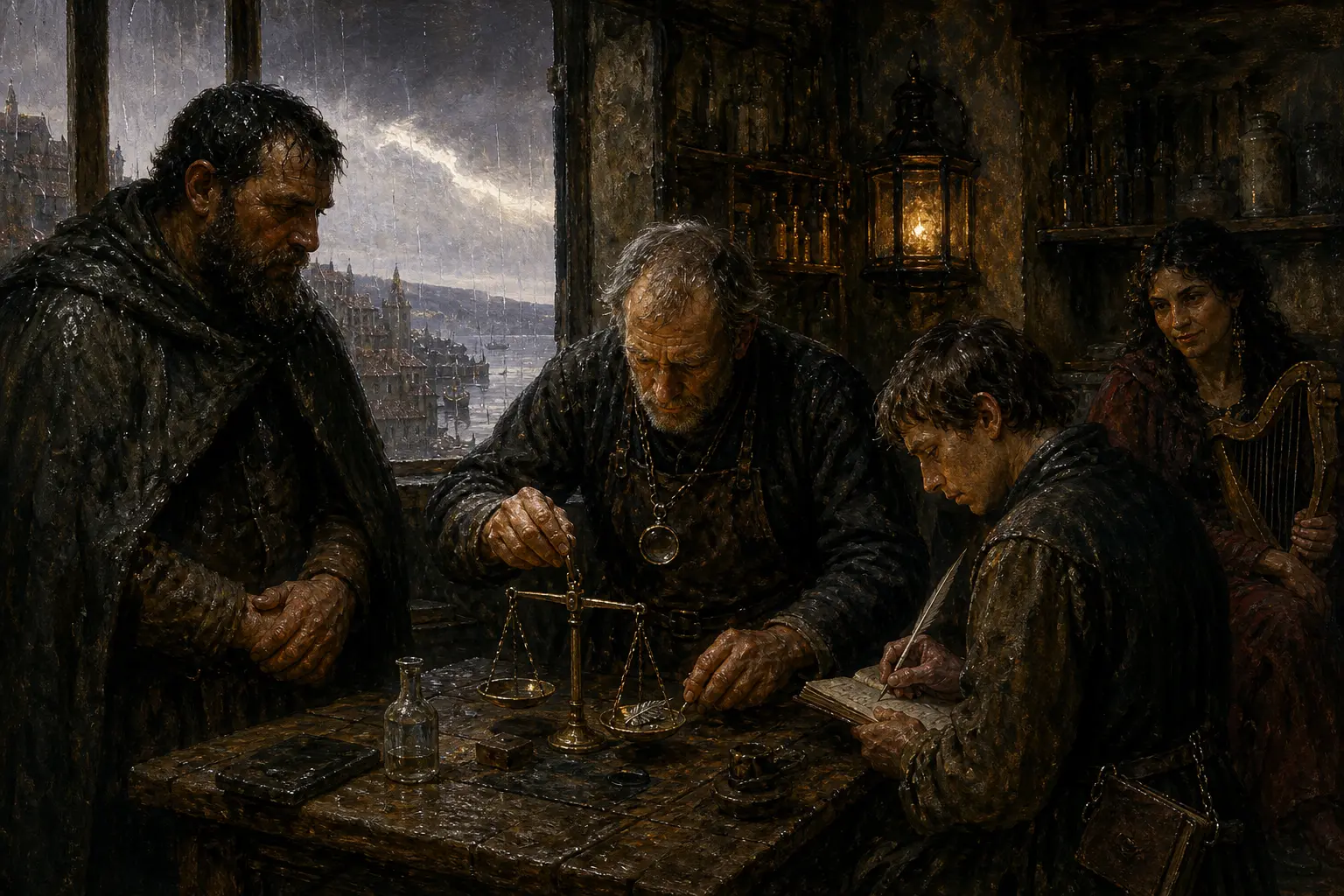
Rain is the one thing in Saverra the charter-houses have never learnt to weigh, and on the fourth of Mistmonth it came off the bay in ropes. I climbed the Salt Stairs with my harp under my cloak and my boots going slick on the pale steps, past the salt-racks dripping on the western quay and the moneychangers shuttering their boards, because I had paid a penny for a rumour and meant to squeeze two pennies' worth out of it. The rumour was this: a river-man down from the Sull had come up the stairs that morning with grey metal wrapped in sailcloth, and Master Damaso Ferro had shut his shop for a private assay. Grey metal, in this year of our empty throne, means one thing only to any fool with ears. It means the Mallory Reward — two hundred marks for metal of the old imperial forging — and every river-rat between Caldmere and the sea turning his grandmother's sewing-box inside out.
The Salt Stairs are what their name says: a quarter of steps above the western quay where the goldsmiths and the changers keep their shops, on the sound principle that a man carrying coin uphill in the rain moves slower than a man carrying a knife. Ferro's place is the third door past the cistern, a brass pan of grey ash hung beside his sign for the Collegium's warrant — since Frostmonth the Bourse of Nine Benches has been queueing round the block with claimants, and the Collegium licenses the small shops to take the overflow, at a price it does not print on the door. The prices it does print were chalked on Ferro's board: half a mark for the touch, half a mark for the sealed record, no refund for bad news. The bad news is free, you see. It is the writing that costs.
Inside it smelt of lamp-oil, wet wool, and the parting-water that bites the back of the nose like hot brass. Ferro himself is sixty if he is a day, all knuckles, in a leather apron stained black at the fingertips, a jeweller's loupe on a cord round his neck like a priest's reliquary. At his elbow stood the Collegium's clerk, a hollow-cheeked young Hollowed with his licence-tag at his collar and his remembrance-book at his belt — a palm-sized thing in brown calfskin gone soft as an old glove, the corners worn round as river stones, swinging on a brass chain beside his eating-knife and wrapped in oilcloth against the damp. He had written a note on the back of his own hand in ink: Mist, 4th. Ferro's. Two assays. I never ask them what they have burned to afford their schooling. They never ask what I charge for a song. It is a polite city, in its way.
The river-man stood dripping in the corner, big as a door, with a bargeman's shoulders and a face that had weathered forty winters on the Sull and trusted none of them. Jory Rusk, his name was, and he unwrapped the sailcloth with his thumbs, the way men handle eggs, or snake eggs. The brooch was a leaf-point as long as my thumb, grey metal gone dark at the edges, set with one small grey stone no bigger than a barleycorn. 'Old forging,' Rusk said. 'My grandmother's luck-piece, and her mother's before her. Thornwick country.' Which is the worst pedigree a piece can carry this year, since three false shards were traced to Thornwick's goldsmiths and poor Wystan Penth paid for the last of them with both his hands at the Mint gate. The Parchmarket wants a claimant to disprove Thornwick origin, and no man alive can disprove his own grandmother. So Rusk took the river road south, where League money asks fewer questions and pays in weight you can bite.
Ferro worked the way rich men's confessors listen: slowly, and billing by the hour. He weighed the brooch against the old imperial standard and pursed his lips at the scales. He rubbed it on the black touchstone, and the streak came up grey-yellow and hopeful, as the new false ones do — they wash them in something that passes a first touch, the goldsmiths call it the grey-wash, and charge accordingly. Then came the parting-water. One drop on the filed edge and the metal frothed like a sick dog. Lead heart under a pretty skin. The clerk dipped his pen and made a note; the little book at his belt swung; the rain came down the chimney and hissed in the stove. Last of all Ferro prised the barleycorn stone free of its setting and drew it across a pane of glass. It cut a clean white line. He looked at it a moment longer than the work required, and set it apart from the brooch, the way you set a bone apart from the meat.
'False,' Ferro said. 'Lead and wash. The stone is river-spar, honest enough, and the mounting is forty years old, perhaps fifty. It is not three hundred.' Rusk swore a Sull oath about his grandmother's virtue, which I shall not set down, the archive being a respectable house. Then Ferro did the thing I had come to see without knowing it: he opened a discretion-purse and counted out two marks of Saverrine weight. 'Consolation,' he said. 'The warrant buys the failure. The piece stays with me, and does not go home to be sold twice.' That is the Collegium's charity, mark you — it keeps bad metal off the street, and keeps the street from asking why. Rusk got two marks for a brooch worth sixpence and went down the stairs to drink them, and I went with him far enough to sell him a verse for one.
I climbed back up for the warmth of Ferro's stove, as one does, and was tuning by the fire when the second visitor came in out of the wet: a spare man in good dark wool, unhurried, the Morel tally-mark stitched on his glove-seam. Severo Cantel, factor to the House of Morel — the man who once offered a widow a hundred marks for a single page of her dead husband's ledger, and is not known to spend a brass shaving without the house's reasons behind it. He bought the sealed record of Rusk's assay. Then he bought fair copies of every failed assay in Ferro's book for the month past — eleven of them; I counted by the page-turns — paid in full weight without haggling, and asked after nothing else. Not the brooch. Not the stone. He bowed to the clerk, nodded to Ferro, and went out into the rain with the papers inside his coat, and Ferro weighed the coin twice and smiled at nobody.
Now here is the shape of it, and I give it to the archive for nothing, which shows what this weather does to my wits. Osten Mallory's two hundred marks have every hedge-lord and ditch-poet in Varrow hunting the true shard — a piece of the Sundered Crown, say it plain, the broken crown that broke the world. But Old Weight's factor is not buying successes. There have been no successes. He is buying failures: eleven wrong roads, written and sealed, from one shop on one staircase in one city. And my sisters of the taproom sing that men with silver knots on their purse-strings have been doing the same at assay-shops in Low Pell and Cassaro all the season. That is not a hunt. That is a map. Somebody out there is not searching for the true metal so much as charting every false one, and I would give my best harp-strings to know what pattern they expect the lies to make when you lay them side by side on a counting-house table.
Rusk came down from Thornwick town / with grandma's luck in sailcloth bound; / the water bit, the grey ran thin — / two marks for what the lead kept in. // If crowns were found by digging, friend, / the ditches would be crowned by spring; / but stone that cuts the glazier's glass / cuts more than glass, at last.
As for the little grey stone, it did not go into any record Cantel paid for. Last I saw, it sat in Ferro's own purse, with others like it — I heard them click when he set the purse down, and I have been paid to notice smaller sounds. So: the House of Morel keeps its famous Grey Book of judgements on the great houses, and now it keeps a book of small grey failures besides. Who buys the map of every wrong road, if not a man who already knows the shape of the right one? That is what I sang at the quayside last night, and it earned me four pennies and one thrown mussel-shell. The truth is a poor earner in Saverra. But it keeps, like salt fish, and one day somebody hungry will pay my price for it.
Page history (1 revision)
- Day 4, 4 Mistmonth, 312 AS Written: Told by Sefa Morrow. 1,510 words