The Salt-Farmer's Testimony
A tale told by Brother Oswin of the Archive
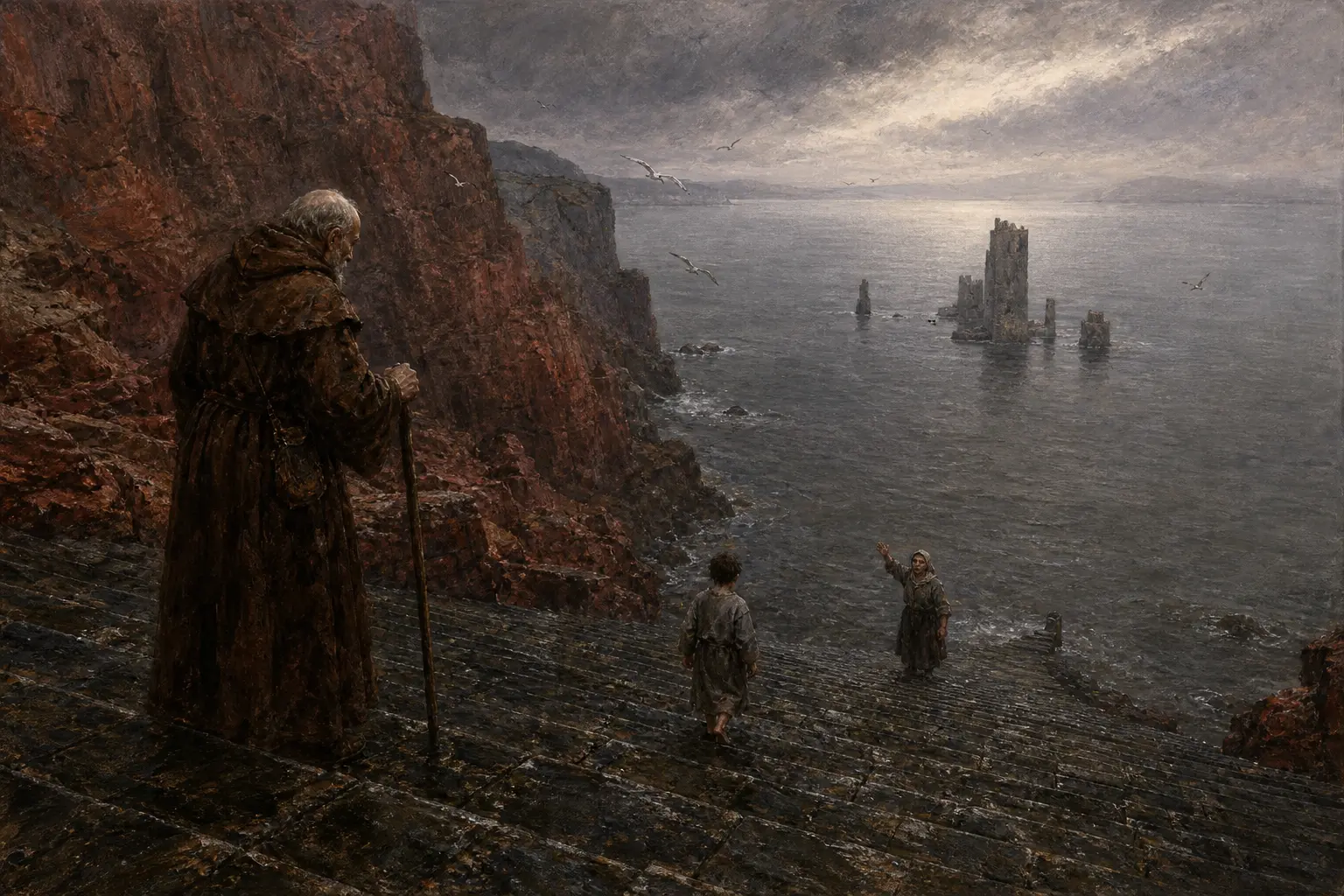
I set this down on the first day of Mistmonth, in the tallyman's loft above the harbour at Stairfoot, with the rain coming off the sea in grey ropes and my fingers too old to hold a pen steady after the climb. The Archive sent me because a woman here has sworn a thing that no one living has sworn before her: that she followed one of the Grey Pilgrims down the Stair of Ilm itself, and stood close enough to touch him when he reached the water. I have taken her testimony word by word, as she gave it, over two evenings. Where I doubt her, I have said so. Where I do not, I have said that too, which may trouble my superiors more.
The witness is Lowena Kest, a widow of perhaps fifty years, a salt-farmer by trade. She works four brine pans cut into the bench of red rock above the village, a quarter-hour's climb from the stairhead. Her husband is nine years dead of a coughing sickness; her son, Bren, died of fever in the first winter of the Long Winter, aged seven. She buried him in the field above the pans, in earth, as her people bury. The burning question divides the coast as it divides everything, and I did not press her on it. She paid for my lodging with eel pie and a bed that did not leak, and she asked no money for her account, which the Archive notes with approval, since bought testimony is worth its price.
"He came along the Salt Road out of the east," she told me, "on the last fair morning we had, which was nine days ago. I was skimming the third pan. You could see him from far off because of the grey, and because of how he walked. They all walk the same. As if the road were carrying them and not the other way." She has seen the pilgrims pass all her life, as everyone on this coast has; she reckons she saw four in the whole of her childhood, and has seen eleven since the thaw. I checked this against the tallyman's book of the Westward Count, which records twelve for the year, and I find her memory better than his ink, which is no small thing in a witness.
Tally of the westward passage, year 312: Eleventh month past, two, being a man and a woman. Second month, three, being men. Fourth month, one child, alone. Sixth month, two men and one woman. Ninth month, three. Tenth month, the Kest woman followed one down, being a boy of nine or ten years by her account. He is counted. The sea has not given him back.
The boy was barefoot, she said, in an undyed grey robe gone soft with weather, carrying nothing, his eyes on the west as they all carry them. She wants me to be plain that she did not mistake him for her son. "Bren was seven," she said, "and dark, and this boy was nine or ten and fair, and I am not a madwoman." But she allowed that when the boy passed below her pans, something in the set of his shoulders caught at her, and she stood up from her work with the skimming-rake in her hand, and the best brine of the season flooding in off the spring tide behind her, and she followed. She kept the crown of the road for him and raised no song and carried no fire, for she keeps the Three Courtesies as her mother taught her, and she followed at forty paces, she says, no closer.
He went down through the village without turning his head. The fishermen mending nets by the slipway stood aside for him as they always do, and old Mother Venn made the sign against harm, which she does at pilgrims and tax-collectors alike. At the stairhead the boy did not pause. Lowena describes the Stair better than any surveyor the Archive has hired: forty paces wide, she said, of green-black stone that is cold even in summer, the upper treads worn down in the middle like old doorsteps and whitened with salt, the lower ones going green with weed. She counted the steps going down, because counting is a salt-farmer's habit — you count brine, you count gulls, you count tides. She counted four hundred and eleven to the weed line, where she stopped counting because she was frightened. The archive will observe, drily, that this agrees with no count previously recorded. The archive observes that they never do.
The tide was at the ebb, and the towers of Tregaron stood in the shallows to the south with their windows full of grey sky, and the boy walked down into the sea as a man walks down into a field. "He did not swim," she said. "He did not wade, neither, not the way you wade, pushing. The water took him the way the road took him. I called out once. I am ashamed of it, calling out, but I did. I said, boy, the tide. He did not turn." By then she had followed him below the weed line, onto the treads that are green and slick and furred with barnacle, where no one in Stairfoot goes, because the village buries its drowned and does not go looking for them.
Here the testimony becomes difficult, and I record it as she gave it, in her own order, which is not the order of events. She caught his sleeve at the water line. Her hand remembers the cloth seam by seam, she says: a patched cuff, a threadbare grey that was soft as pounded nettle. She remembers the cold of him through the cloth, cold as the sea in early spring. And of his face, which she must have seen at an arm's length in clear morning light, she can tell me nothing. Not the colour of his eyes. Not the shape of his mouth. "I could draw you his sleeve," she said, and her hands turned over in her lap as though the sleeve were still in them. "I could not draw you his face. I have tried nine days. There is nothing there to draw. Brother, I have buried a child. I know what grief does to a memory. This is not that."
She did not hold him long. She does not say he pulled away; she says her hands simply opened, the way hands open when you are very tired, and he went on down, and the water came up his grey robe to his knees, and then to his shoulders, and then the grey sea closed over his head without, she swears it, a ripple. She watched the place until the light went. No bubbles. No change in the water. The gulls, which follow everything on that coast, did not come near the stair all that day, though she concedes this may mean only that there was no offal on the slipway. She walked back up the four hundred and eleven steps, or however many there are, and found her pans flooded and the season's best brine gone back to the sea, which she says was a fair price and she would pay it again, and this is the only part of her testimony I am certain is a lie, because she wept when she said it, and not for the boy.
Now the doubts, since an archivist who records none is a clerk and not an archivist. The tallyman Gwynn did not see her on the Stair, being at his dinner, and no fisherman will swear he saw her below the weed line. The morning was bright and low-sunned, and she admits she looked away when she gripped the sleeve, looking at her own hand on the cloth. I asked her the question the Archive pays me to ask, the one every sworn account of these travellers comes round to in the end: did the boy cast a shadow, there on the whitened treads, with the sun behind him and the whole stair laid out in morning light? She was a long time answering. "I cast one," she said at last. "I remember mine on the stone, because I watched it reach the water before I did. I cannot tell you about his. I have gone over it and gone over it. I remember the stone where his shadow should have been, and I remember it plain, and that is all I can swear to." Plain stone where a shadow should be is not no shadow. I have written it as she said it. Let the Archive make of it what the Archive makes.
A word on what she lost, since testimony has a cost and it ought to be entered in the ledger like any other. The flooded pans will take a fortnight to put right, and she owes a half-share of the lost salt to the charter-house that advances her brine, which is the League's way of owning a woman without the inconvenience of buying her. She took it calmly. Salt-farmers are used to giving the sea its portion; she says the only difference this year is that she knows what the sea spent it on, and I confess I do not follow her meaning, and did not ask her to explain it, which may be the cowardice of an old man who has to sleep in a bed above the sound of that water.
I will record one thing more that is not testimony, only observation, and the Archive may strike it out if it pleases. Before I left I walked down the Stair myself at low tide, as far as the weed line, with my heart going like a hammer, and counted what I could. I will not give the number. The sea was grey and ordinary and very cold, and there was nothing on the lower treads but weed and barnacle and one small grey thread, caught on a barnacle's edge, which the next wave took. The Wardens keep apart from the pilgrims by their practice and will not be asked, and I am old and have not asked. But there were two more grey figures on the Salt Road as my cart came east this morning, walking west against the wind, and I yielded them the crown of the road, and raised no song. Mistmonth is come, and the Count stands at twelve, and the tallyman has sharpened a new pen.
Page history (1 revision)
- Day 1, 1 Mistmonth, 312 AS Written: Told by Brother Oswin of the Archive. 1,760 words