The Feast of Unpaid Debts
A tale told by Sefa Morrow
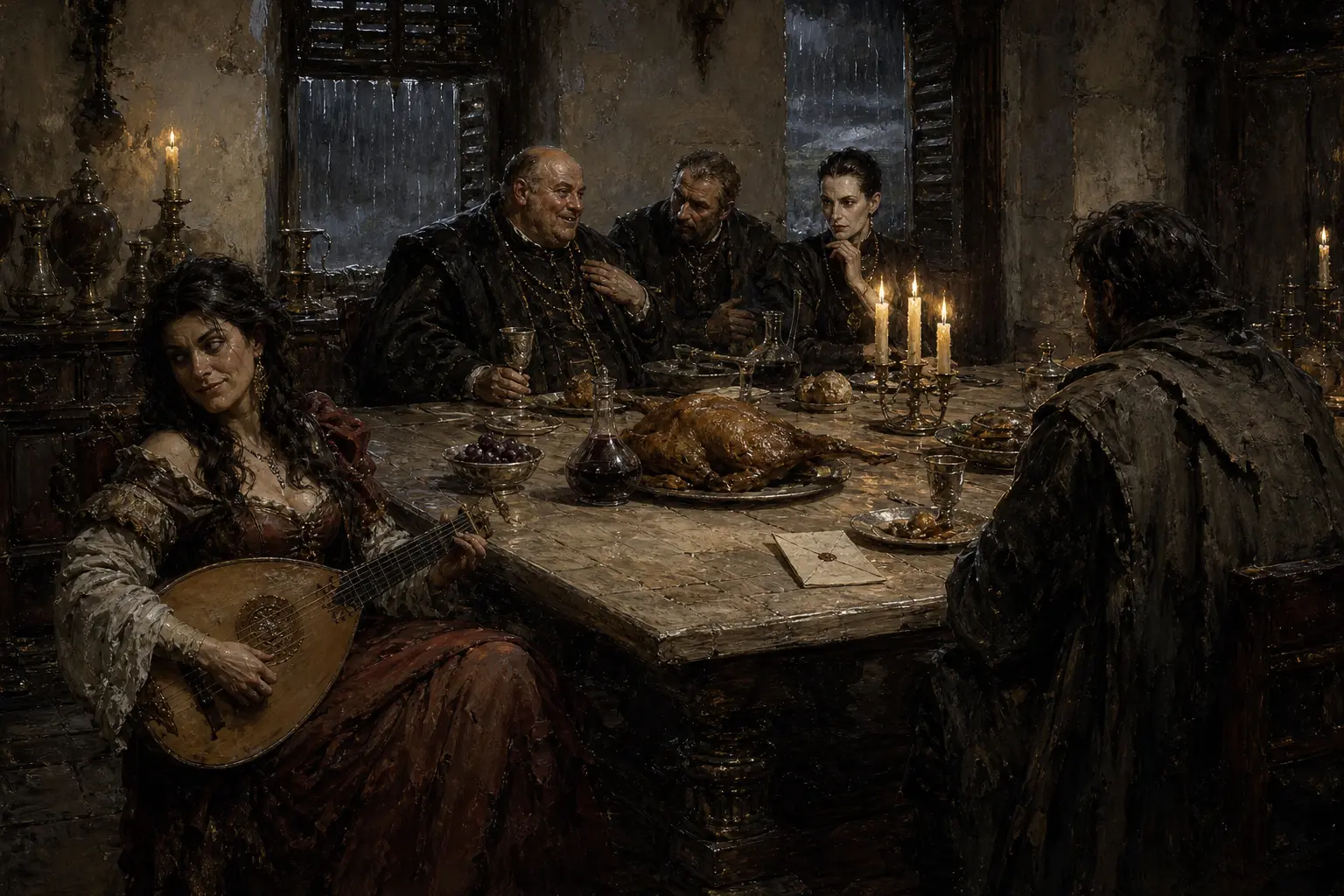
They paid me six marks to sing at Lucan Morel's table on the first of Mistmonth, and I would have paid six of my own for a seat in the corner, had I known what the evening was worth. Six marks is good money in Saverra — a dockhand earns it in a month — but the Morel house eats beeswax candles the way other houses eat tallow, and there was a goose on the sideboard the size of a ferryman's dog, so I put the price of the evening down as considerable before the first cork was drawn. I tuned my lute in the pantry and watched the rain come in off the bay, grey on grey, and over the roofs the Wound showing faint and milk-pale the way it does when the year turns cold. The red lamps were burning on the western quay — three plague-houses marked this month, which is two more than last — and nobody at Morel's table spoke of that either. Rich men believe plague is a poor man's habit, like debt. They are half right. It is like debt in that it always comes home.
The guests were few, which is how you know a dinner matters. Any fool can feed forty. When Morel seats six, six people in the Reach are about to have their lives rearranged. There was Bastia Quince of the League's House of Quince, thin as a pen-line, who counts coin the way priests count sins — lovingly, and without forgiveness. There was a clerk from the Saverrine Vaults who never gave his name, which in Saverra means he is the Vaults' name. There was old Morel himself, fat and pleasant, who has ruined more men with a smile than Brant Halloway ever will with a rope. And there was me, which tells you the sixth seat was meant to look like nothing at all.
The sixth seat was late, and came in mud to the knees. Master Anselm Vey, envoy of the Regency of Varrow, nine days from Caldmere by barge and hired horse, with the river damp still in his cloak and the look of a man who has been rehearsing a speech since Harrowgate and lost it somewhere on the stairs. They sat him at the foot of the table, which is where you sit a debtor, and they gave him the good wine, which is how you soften a debtor, and Morel asked after the Lord Regent's health with the tender interest of a man reading a weather report.
"The Lord Regent is comfortable," Vey said, which is what you say about a dying man when the word dying is bad for business. "He sends his regards, and his letter." He laid it on the cloth, and I craned my neck over the goose-grease candlelight like the professional I am. A plain seal, the Ardent hart pressed a shade off-centre, and under it a clerk's note that the letter was written in the hand of the Lady Maud, the Regent's sister, and sealed by her, since Edric Ardent cannot now raise his own signet and it hangs on a cord at his neck. I have seen many letters in my trade. That is the first I have seen that admitted, in its own wax, that the man who sent it could not have sealed it himself. Bastia Quince looked at that seal for a long moment, the way a doctor looks at a tongue.
They did not open it until after the fish. That is a Saverra insult so refined that Varrow men never feel the blade. So while Vey sat with his letter unopened and his wine refilled, I did what I was paid for, and I gave them the old one, the one they always ask for in the League when a Varrow man is in the room, because it reminds him whose money kept his grandfather's wars fed.
She burned the road she walked as a girl, She burned her mother's face, She burned the name of the man she loved To buy the realm its grace — And when the fire had eaten all And the steppe-horse turned to flee, She asked the captain at her side What her own name might be.
They all hummed the refrain, even Vey, who should know better, it being Maera Tor who emptied herself to save his realm from the Khaddan. That is the thing about that ballad. Everyone loves it. No one wants to be in it. When I finished, Morel dabbed one eye — he can do it on command, I have watched him — and opened the letter with a fruit knife, and read it the way men like Morel read everything: twice, and once more for what it does not say.
What it said, in essence, was more time. The Regency's loans had been called in the spring, as every servant in Saverra knows, and the League had put its own factor in Caldmere's council hall to watch the seven houses glare at one another over old Edric's Quiet Compact falling apart like wet thatch. Vey spoke well, I will give him that. He spoke of the Amber Gate and how Ardent had held it in the riot year. He spoke of the Almoners' Riot put down and the grain barges running again on the Sull. He spoke of the dignity of the realm. He did not speak of the Sundered Crown, because there is nothing to say about a thing that has been in pieces for three hundred years, though the Crown-men in Caldmere will talk your ear off about it for the price of a pint.
Morel let him finish. Morel always lets them finish; it costs nothing. Then he said, very gently, that the League's difficulty was not the sum but the signature. A loan to the Regency was a loan to no one, he said, the Regent dying, the Council not met in a year, seven houses with seven hands and no name to put to a bond. "Whom do we lend to, Master Vey?" he asked. "Name me the man who will honour this paper in five years, and I will lend him my own teeth."
And here I will tell you what I saw from my stool by the sideboard, because a singer is furniture and furniture hears everything. While Vey stammered about the lawful processes of the Council, the clerk of the Vaults — the nameless one — turned his wine cup upside down on the cloth, then righted it, then turned it down again. Bastia Quince gave him one small nod. Morel, carving the goose, said to no one in particular, "Corrow keeps a good table in Thornwick, they tell me. An honest house. Old debts, honestly paid." And the clerk said, "Vane keeps a better cellar and a worse temper," and Bastia said, "Mallory wants a wedding, and weddings are written off," and that, my dears, was the whole of it. Three sentences over goose. I have heard longer discussions about the price of rope. When Edric Ardent dies — and every man at that table spoke of it as a date in a ledger, not a death — the charter-houses of Saverra will know House Corrow for their friend, and Corrow will know the weight of the hand on its shoulder. Whether Corrow was asked first is a question no one in that room thought to raise.
They gave Vey his answer after the cheese, and it was a masterpiece of the Saverrine art, which is the art of saying yes so that it costs more than no. Forty thousand marks, to see the Regency's household through the winter, secured against the tolls of the river Sull for ten years, at a rate I will not repeat in respectable company. It was a third of what he had come for. It was offered with the letter of a dying man lying beside the fruit knife, and Vey signed, because men who carry other men's authority always sign; the shame is not theirs to keep. I watched his hand on the pen and thought of old Ardent's signet on its cord, and which of the two of them had the lighter burden.
One more thing, because I am a gossip and it is my one virtue that I admit it. When they spoke of the Pale Choir's offer — Ilyth the Seventh willing to intercede on Varrow's debts in exchange for the Glassmere handed to his church — it was Vey who refused it, flat, before anyone at the table had to. Ardent had refused it before him. Whatever else the old man cannot lift any more, he can still say no to that, and the bankers were pleased, and their pleasure frightened me more than anything else all evening. I could not tell you why. A banker's smile is only arithmetic. But I have made my living reading rooms, and I tell you the room leaned when the Choir was named, the way a table leans when too many elbows rest on one side of it.
They lodged the envoy in the attic room, under the slates, with the rain on the roof for company, and I walked home along the terraces past the plague-lamps, six marks in my boot and a seventh that Morel had pressed on me at the door "for discretion." I took it. Discretion from a ballad-singer — there is no surer way to buy a song. But I will say this for free, since everyone in the Reach will know it by Candlemass anyway: in Caldmere they believe the question of the age is who rules Varrow next. In Saverra the question was settled between the goose and the cheese, and it was not who. It was how much. We have a saying on the quays — the tide lifts all boats. What we mean, when we say it over a ledger, is that we own the tide.
Page history (1 revision)
- Day 1, 1 Mistmonth, 312 AS Written: Told by Sefa Morrow. 1,678 words